
S/MIME Certificate Requests
This section explains how to create certificate requests for S/MIME Certificate type in the Web RA application.
S/MIME certificate requests with None validation type
S/MIME certificate requests with Mailbox validation type
S/MIME certificate requests with Organisation validation type
S/MIME certificate requests with Sponsor validation type
S/MIME certificate requests with CAA records verification
S/MIME certificate requests with None validation type
The following steps describe how to create an S/MIME certificate request with the None validation type.
Expand Requests > Certificate Requests from the Admin portal to navigate to the Certificate Requests listing screen.
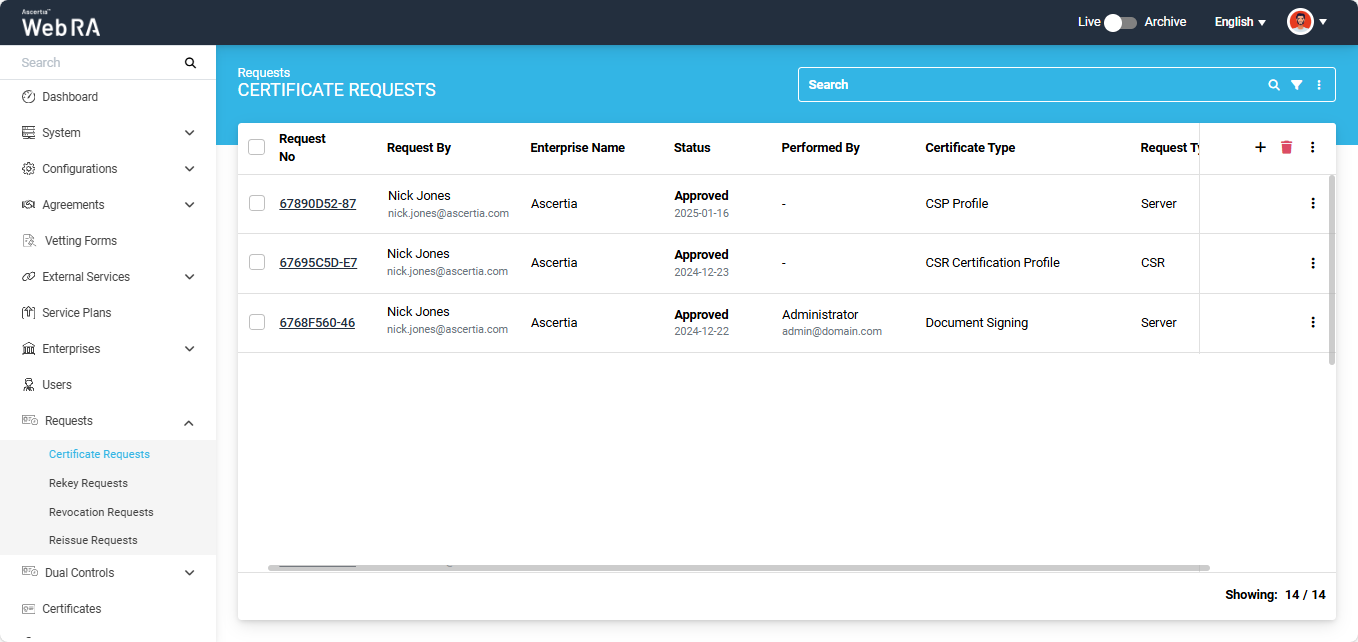
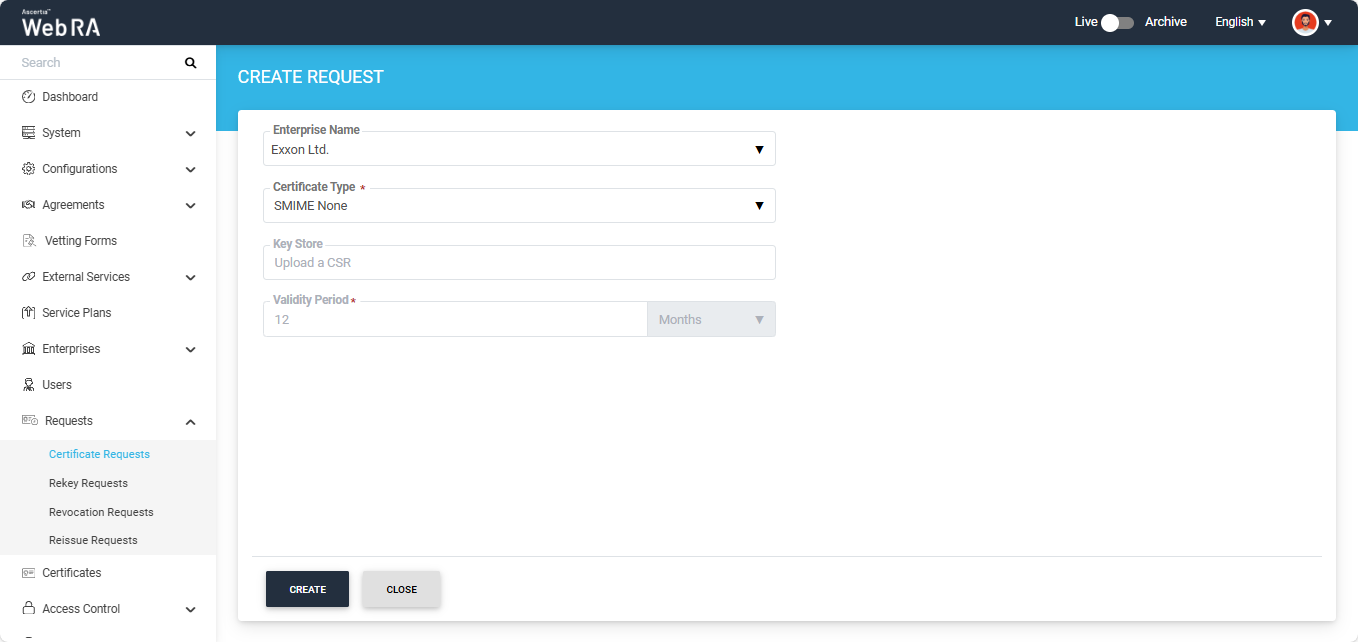
Click the + button in the grid header to access the Create Request screen. Select the Enterprise name from the dropdown, choose the Certificate Type, and click 'Create'.
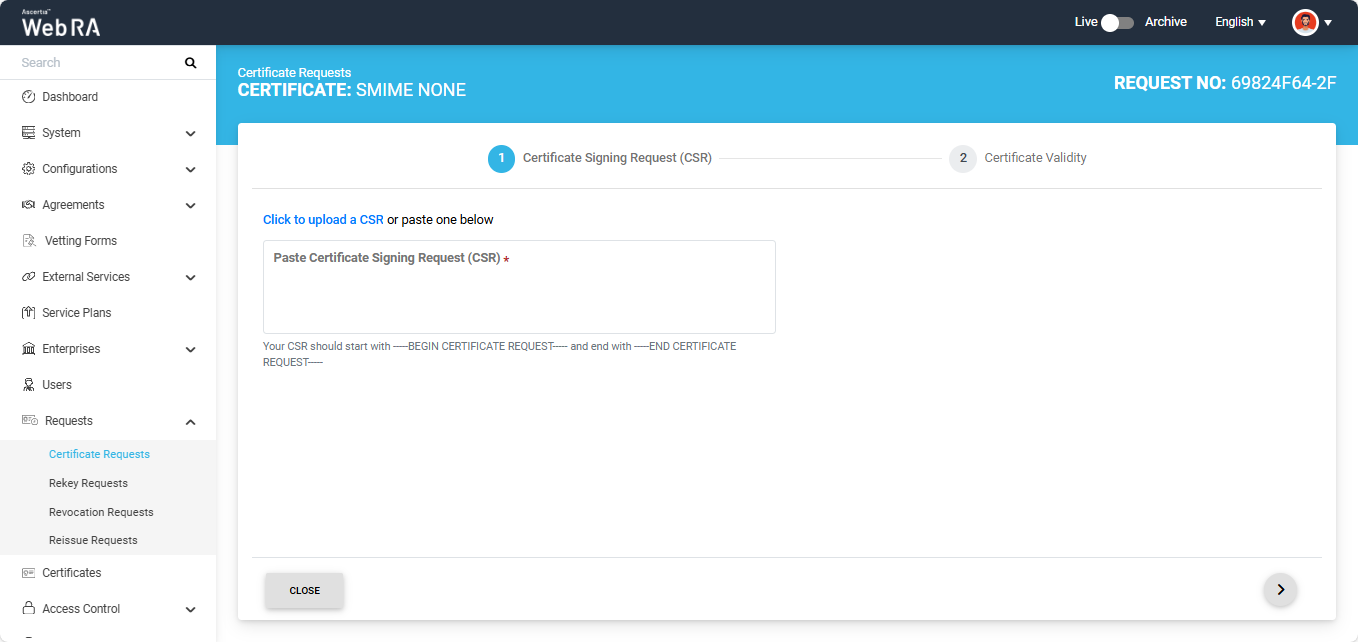
The system will display the Certificate Signing Request (CSR) screen. Here, you can either upload a CSR or paste it into the ‘Paste Certificate Signing Request (CSR)’ box.
Once the CSR is uploaded, the following screen will be displayed.
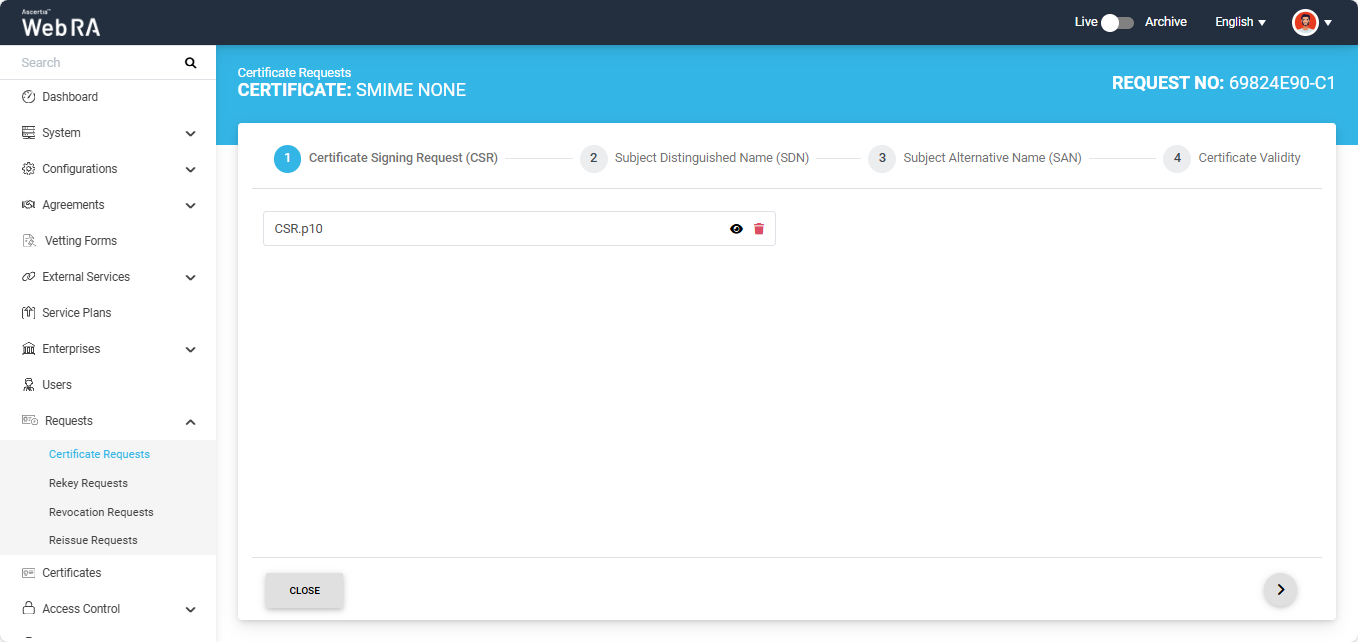
You can click the Eys icon to see the details of the uploaded CSR. It contains all the SDNs, SANs, etc.
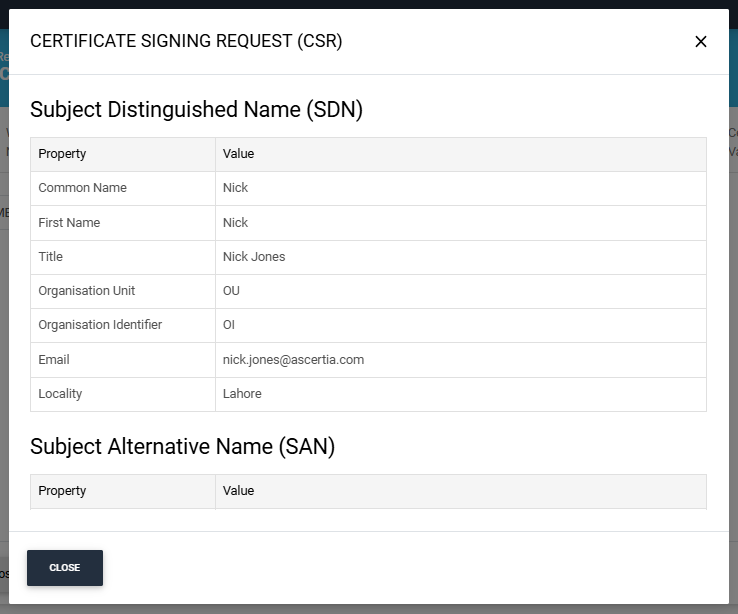
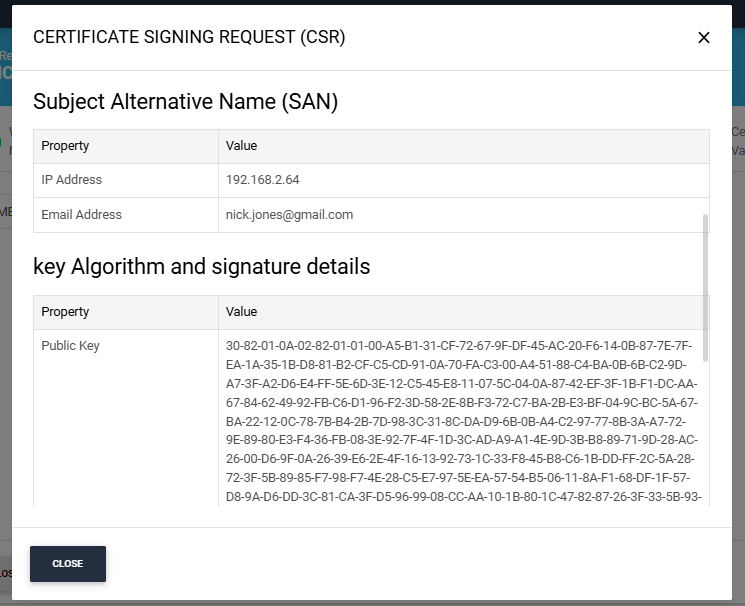
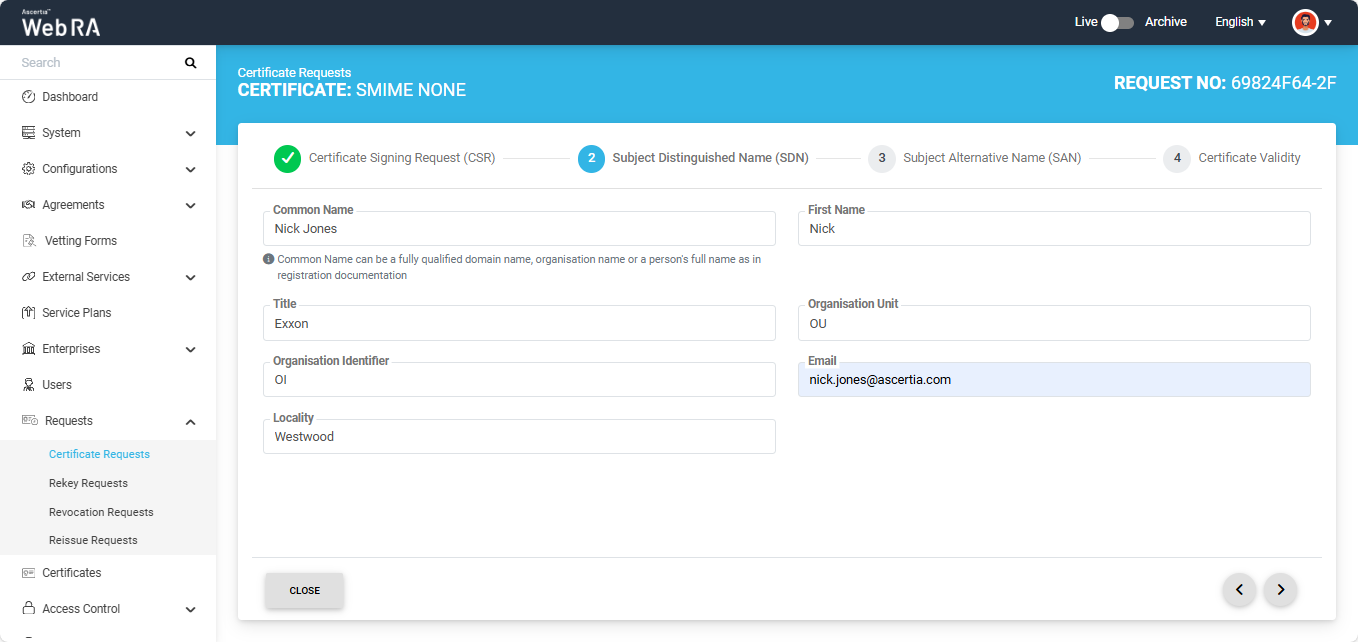
Click the next '>' button to navigate to the 'Subject Distinguished Name (SDN)' screen. Here, review or update the information in the fields as required, then click the next ‘>’ button to proceed.
The Subject Alternative Name (SAN) screen will appear. Here, review or update the information in the fields as required.
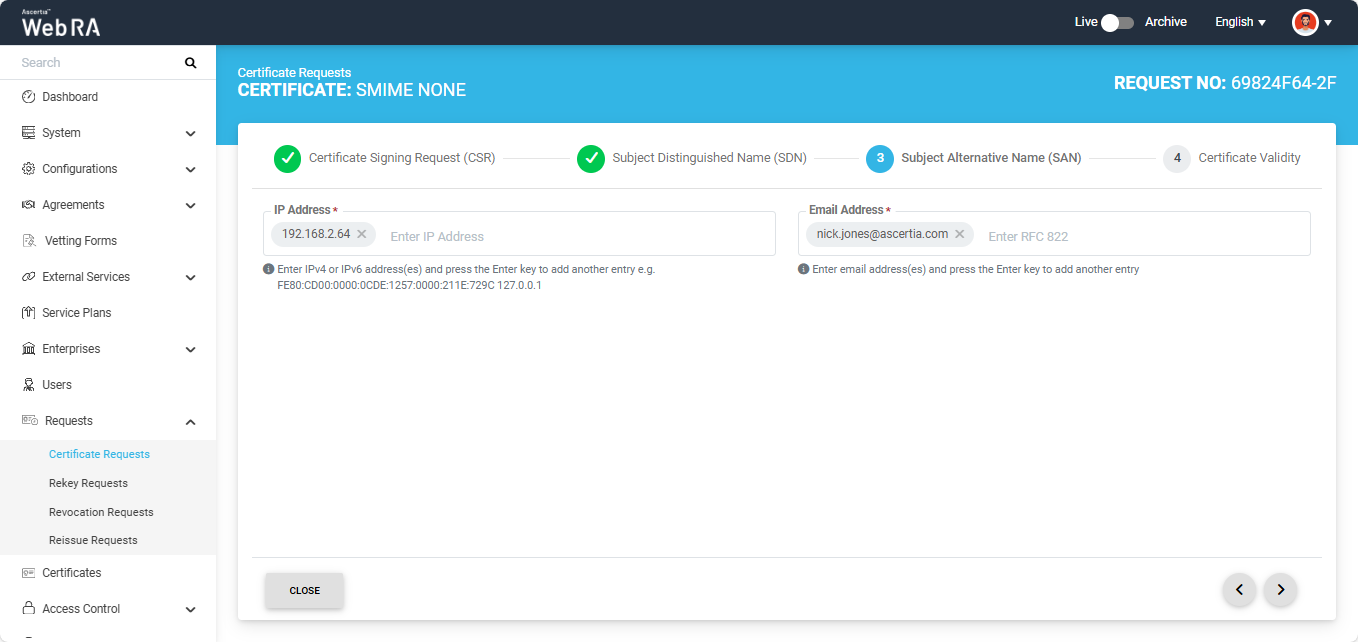
After completing the SAN section click the next ‘>’ button to proceed. The 'Certificate Validity' screen will appear.
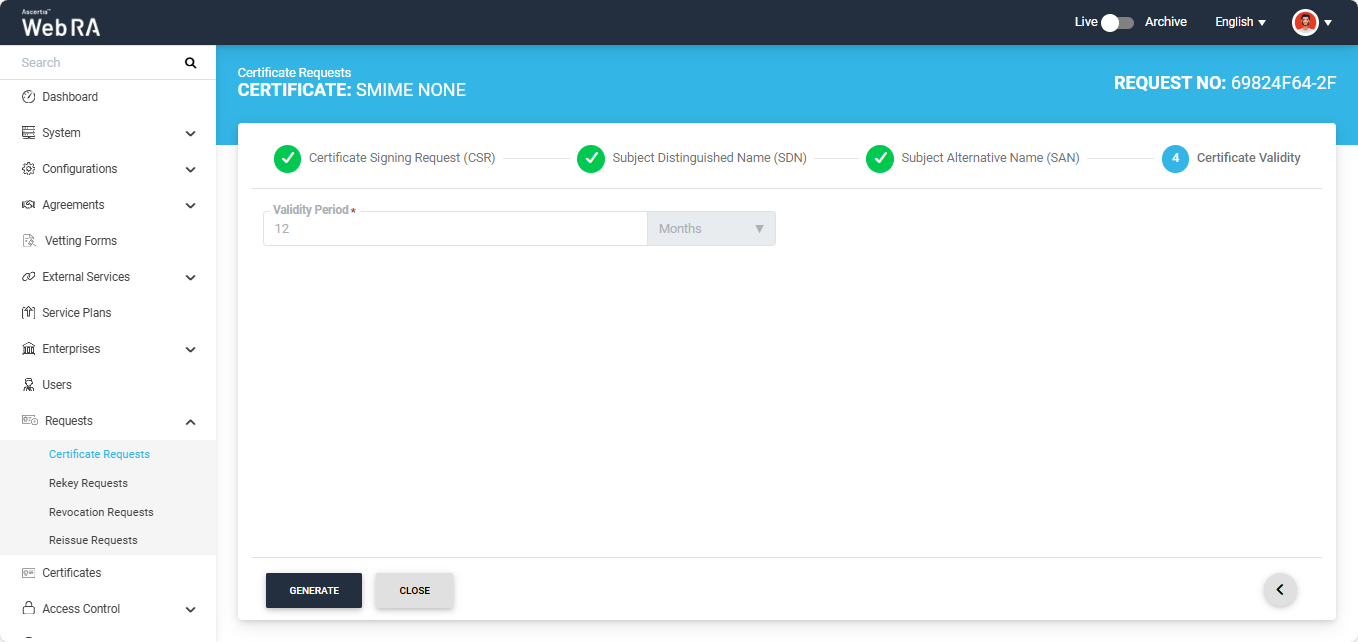
Click the 'Generate' button to create the certificate. The certificate will be created and the system will display the 'Certificate generated' alert on the screen.
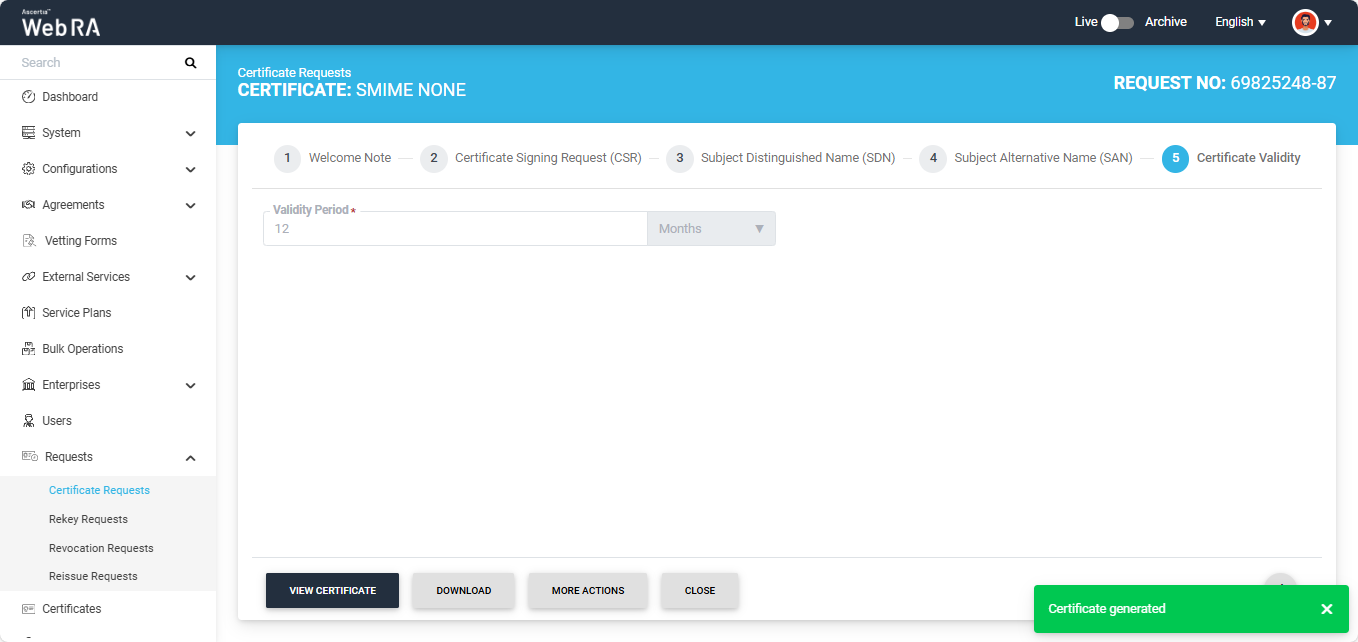
Note: If Certification Authority Authorisation (CAA) Records is enabled in the Enterprise Domain Settings, CAA record verification is required in the Ownership Verification section. When CAA record verification is enabled and the None validation type is selected, the system performs only CAA verification before generating the certificate. Ensure that the domain in the DNS and Email Address fields of the SAN are the same. If they differ, the system displays an error on the SAN screen and does not allow you to proceed. For more details, see how CAA Record Verification is performed.
S/MIME certificate requests with Mailbox validation type
The following steps describe how to create an S/MIME certificate request with the Mailbox validation type.
Expand Requests > Certificate Requests from the Admin portal to navigate to the Certificate Requests listing screen.
Click the + button in the grid header to access the Create Request screen. Select the Enterprise name from the dropdown, choose the Certificate Type, and click 'Create'.
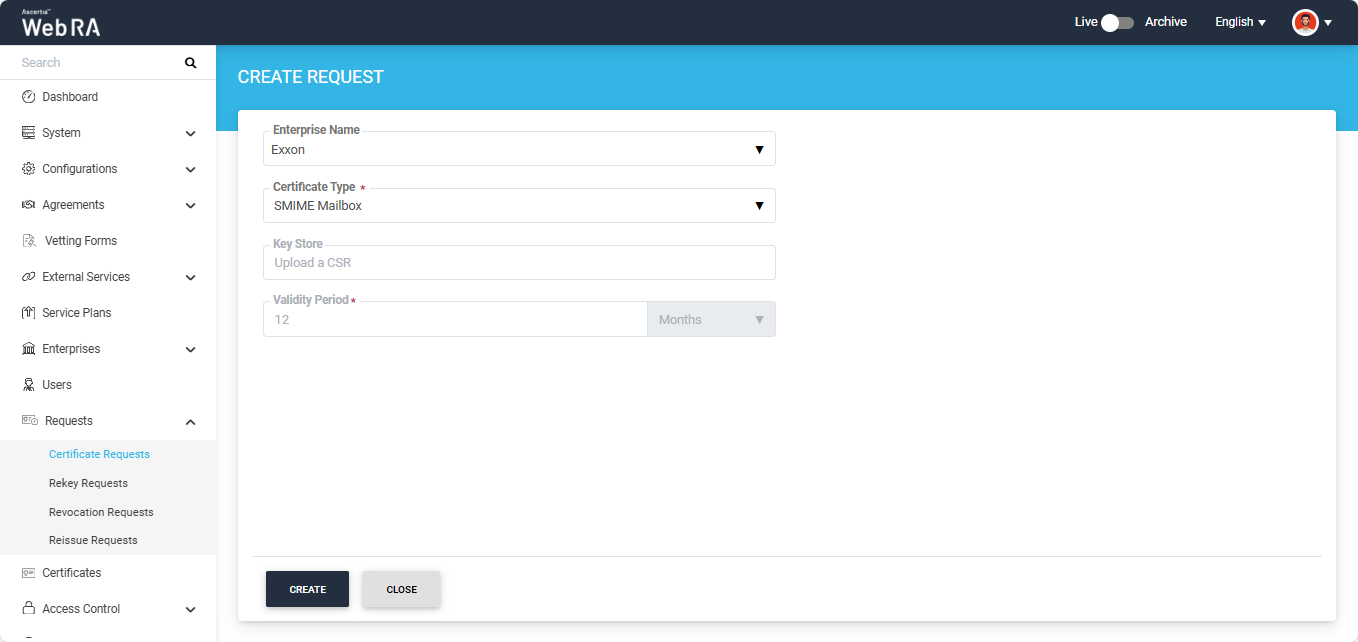
The system will display the Certificate Signing Request (CSR) screen. Here, you can either upload a CSR or paste it into the ‘Paste Certificate Signing Request (CSR)’ box.
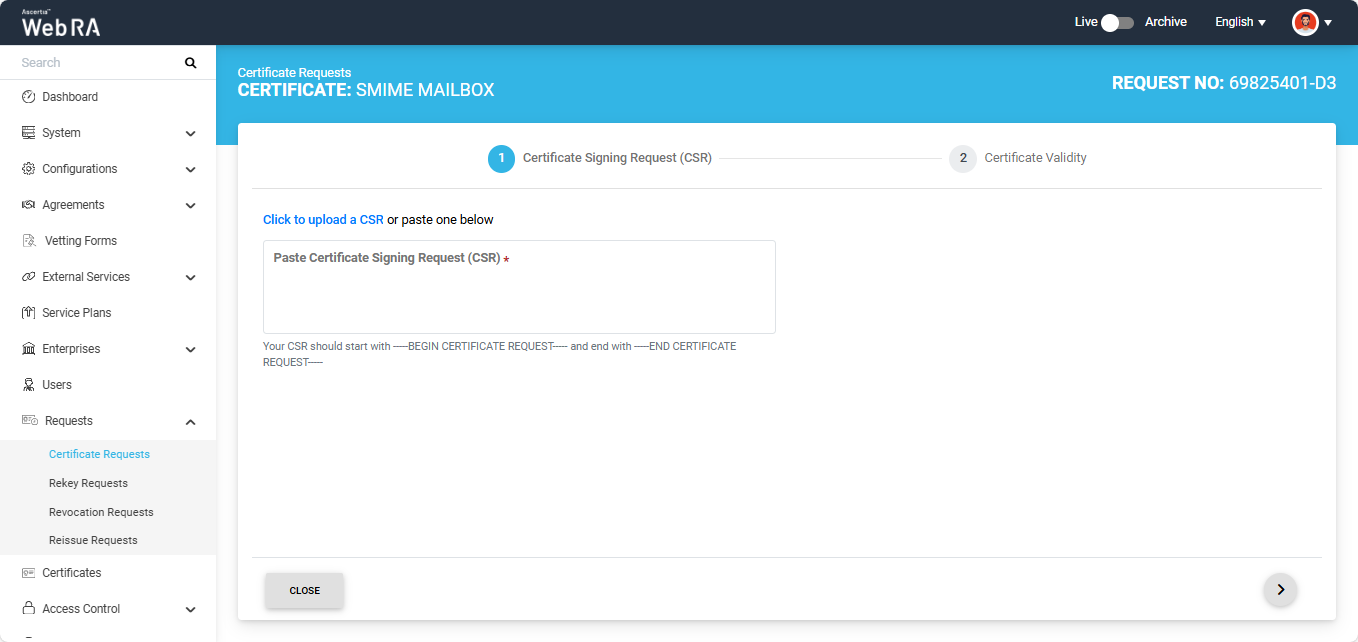
Once the CSR is uploaded, it will appear in the CSR field. You can view the details of the CSR by clicking the Eye icon. It contains all the SDNs, SANs, etc.
Click the next '>' button to navigate to the 'Subject Distinguished Name (SDN)' screen. Here, review or update the information in the fields as required, then click the next ‘>’ button to proceed.
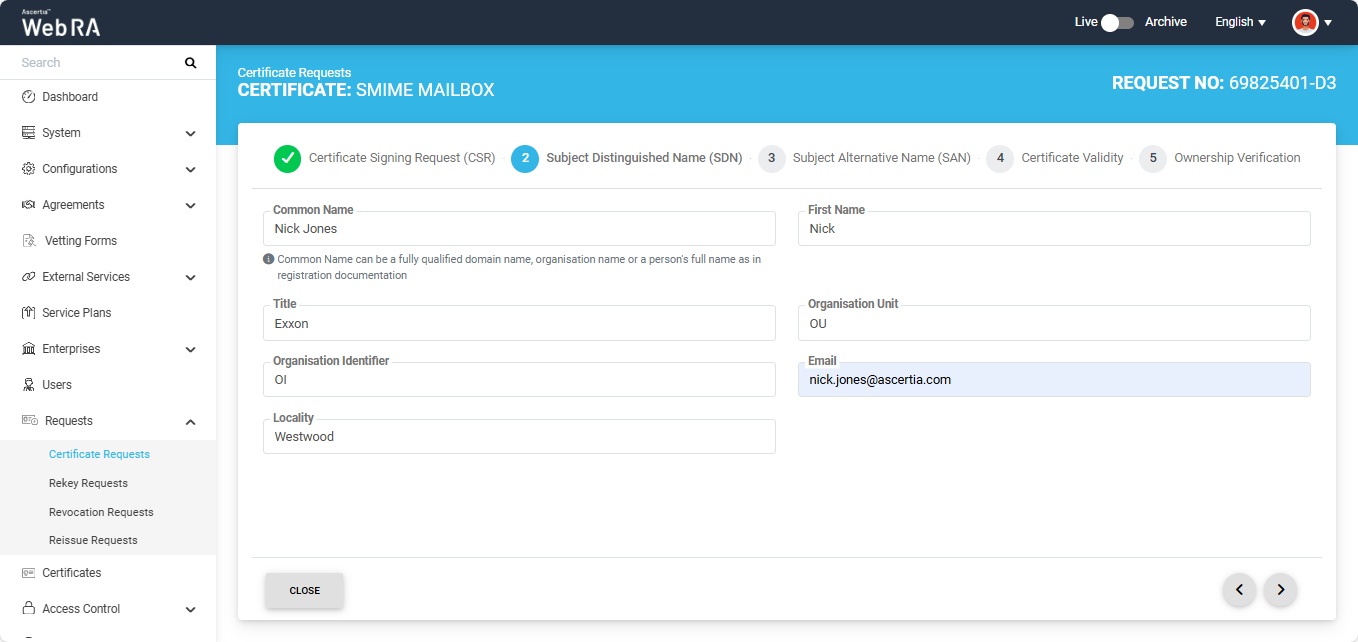
The Subject Alternative Name (SAN) screen will appear. Here, review or update the information in the fields as required.
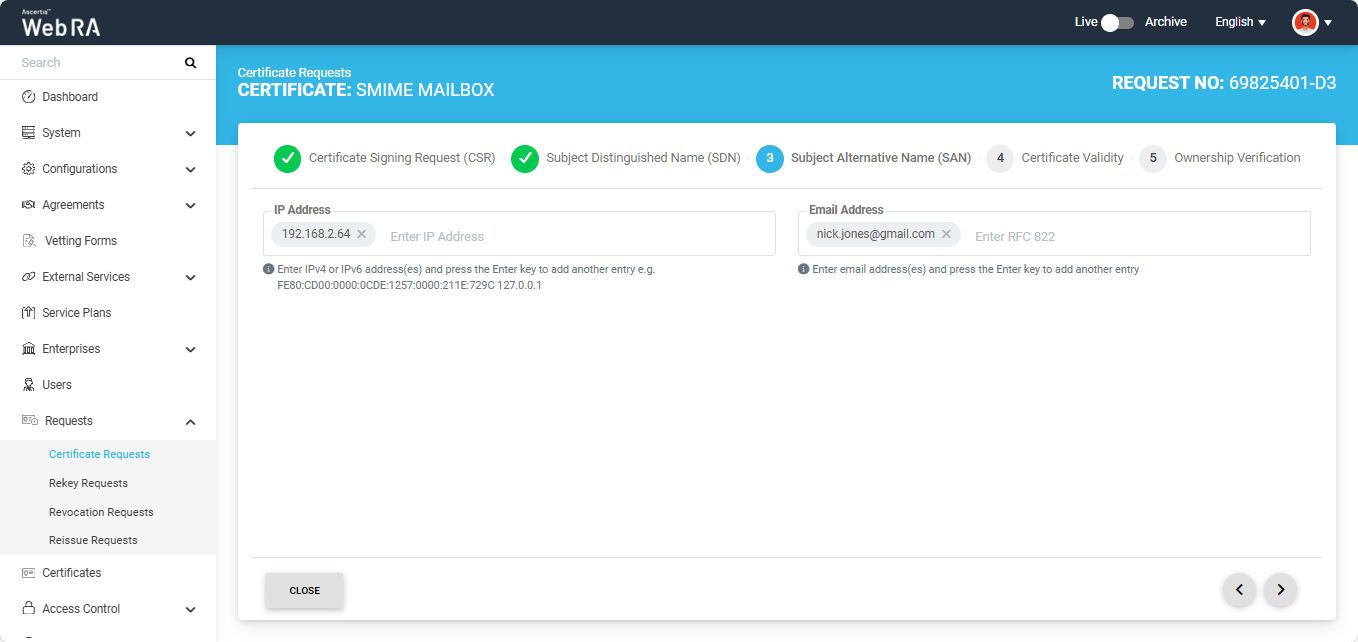
After completing the SAN section click the next ‘>’ button to proceed. The 'Certificate Validity' screen will appear.
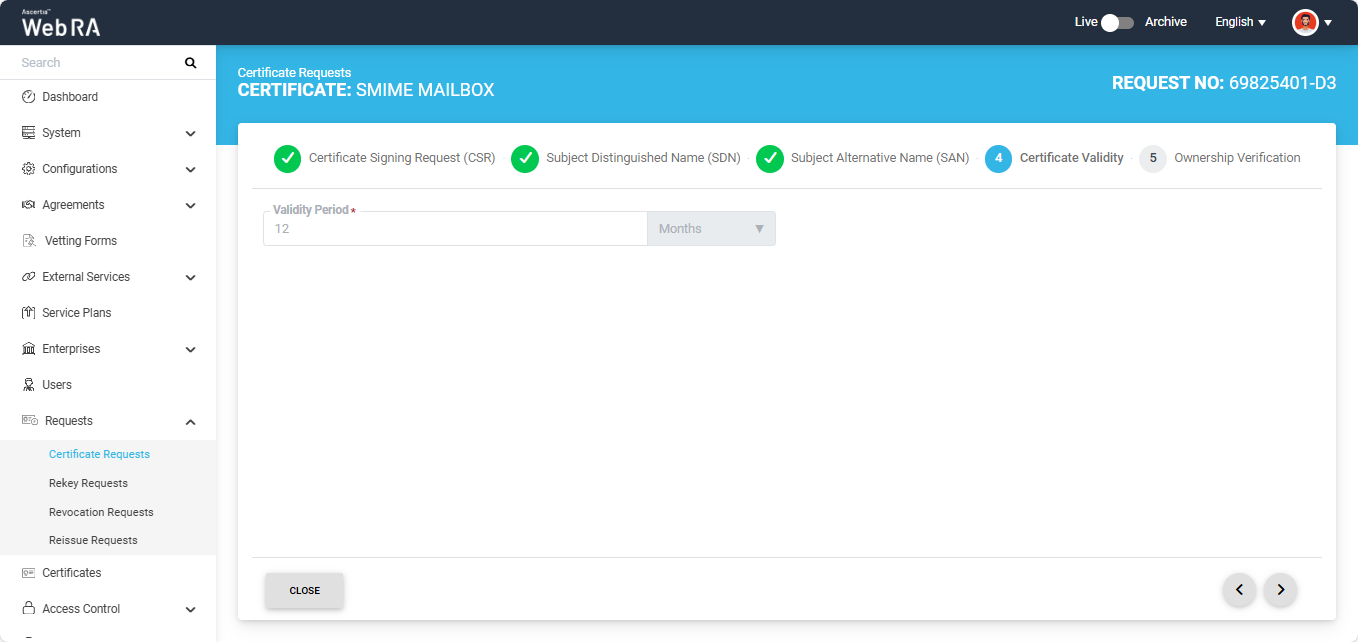
Click the next '>' button to navigate to the 'Ownership Verification' screen. The system will display the 'Email Validation' section on the screen. If the ‘Mailbox’ validation type is configured in the certification profile, email verification would be required in the Ownership Verification screen.
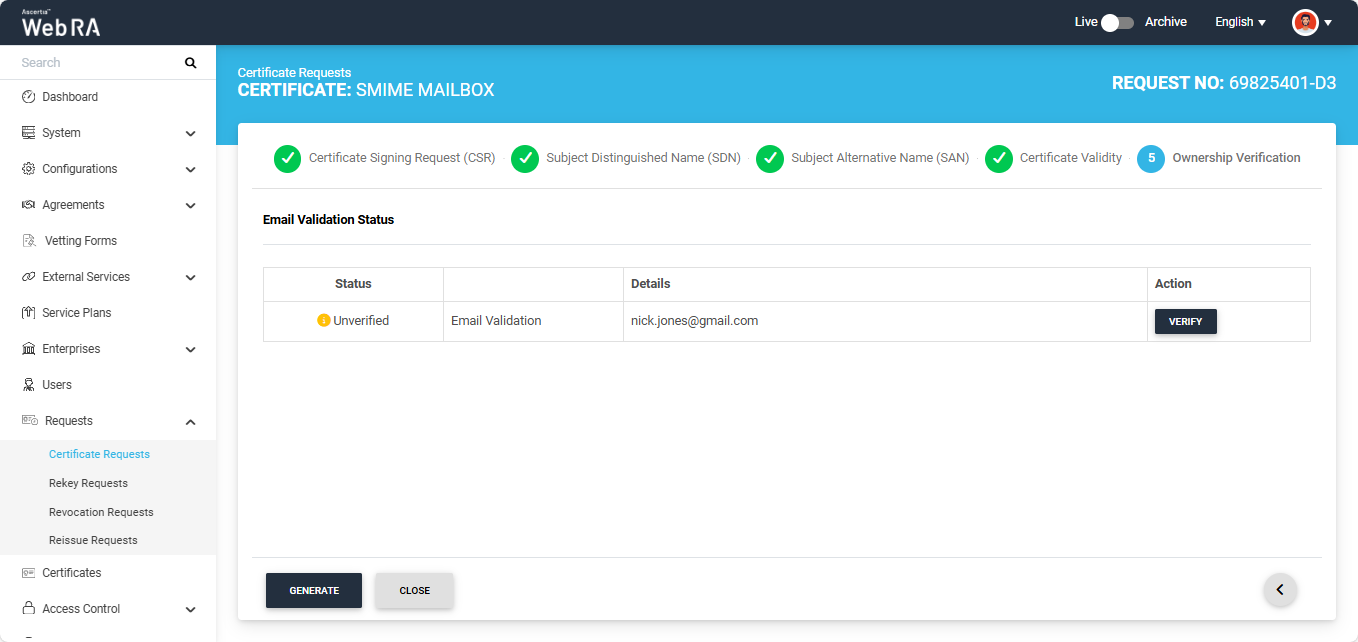
To verify the email address, click the ‘Verify’ button in the Action column. An ‘Email Validation’ dialog will appear on the screen, and a Token will be sent to the specified email address.
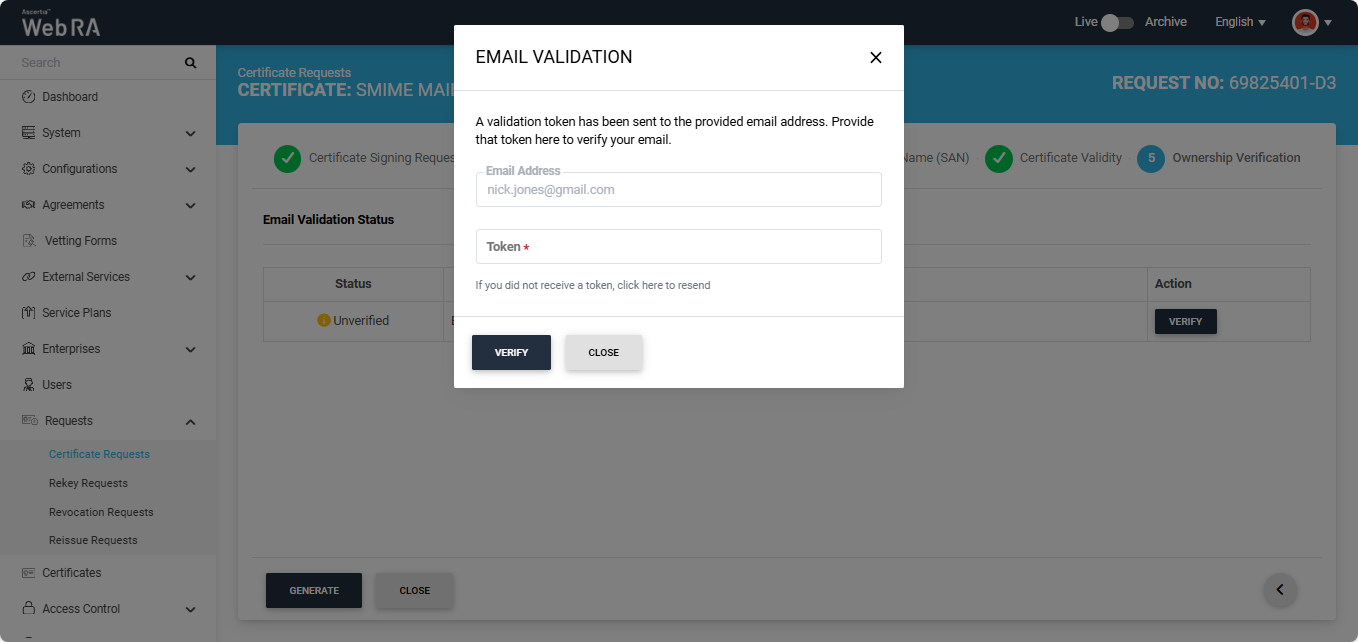
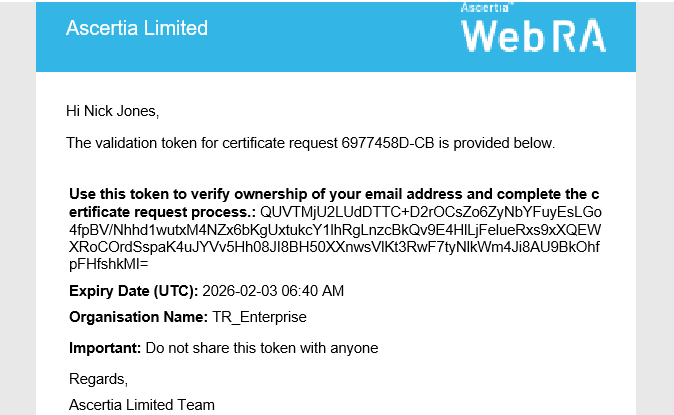
Enter the token you received in your email in the ‘Token’ field, then click ‘Verify’. If the provided token is correct, the system will display the ‘Verified’ status for the email address.
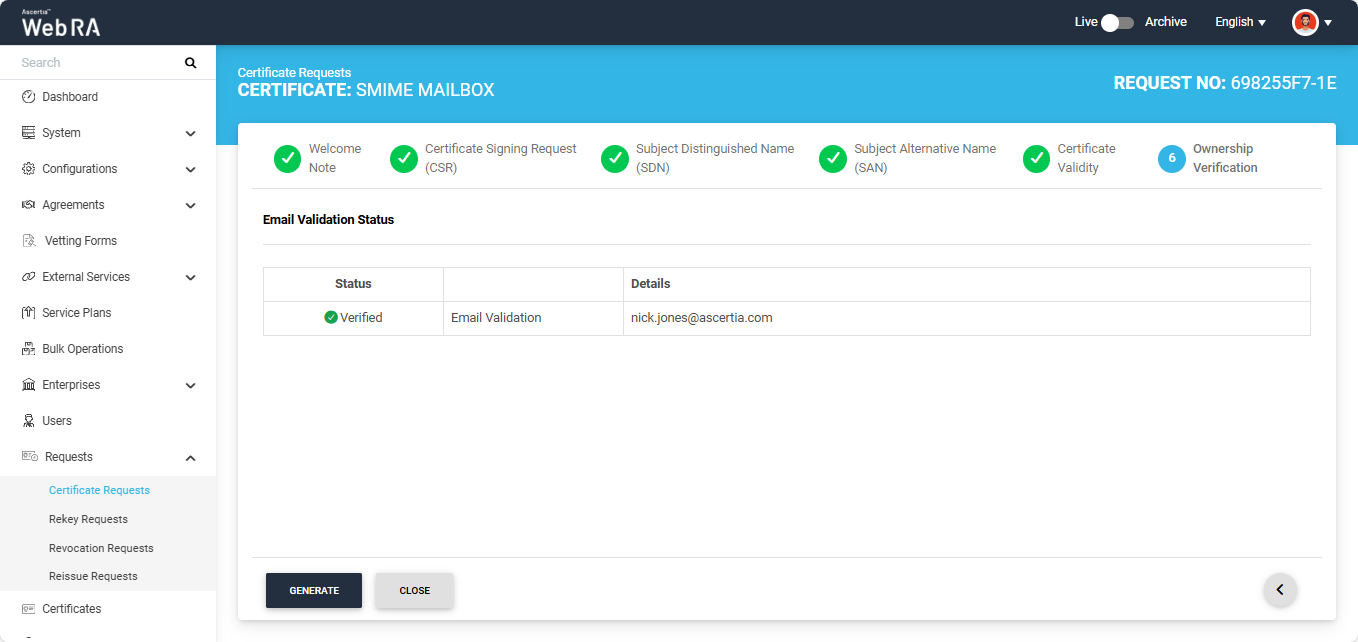
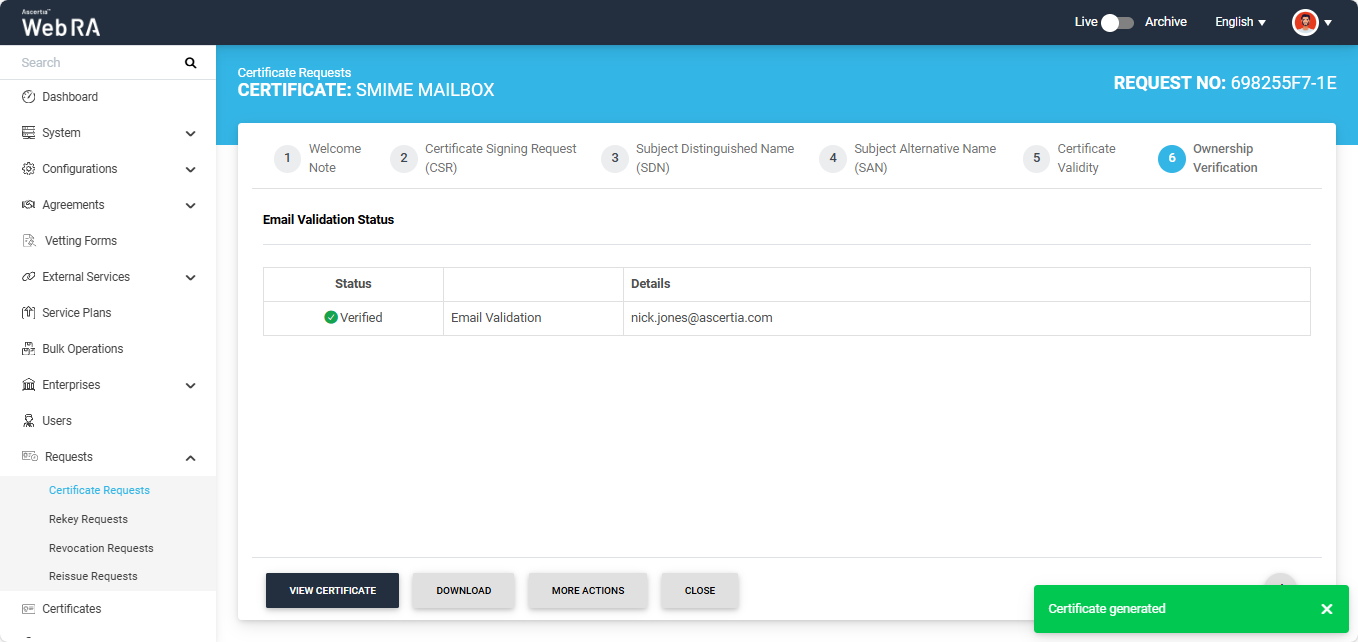
After successful verification, click the ‘Generate’ button to create the certificate. The system will create the certificate and display the 'Certificate generated' alert on the screen.
Note: If Certification Authority Authorisation (CAA) Records is enabled in the Enterprise Domain Settings, CAA record verification is required in the Ownership Verification section. When CAA record verification is enabled and the Mailbox validation type is selected, the system performs both Email validation and CAA record verification before generating the certificate. Ensure that the domain in the DNS and Email Address fields of the SAN are the same. If they differ, the system displays an error on the SAN screen and does not allow you to proceed. For more details, see how CAA Record Verification is performed.
S/MIME certificate requests with Organisation validation type
The following steps describe how to create an S/MIME certificate request with the Mailbox validation type.
Expand Requests > Certificate Requests from the Admin portal to navigate to the Certificate Requests listing screen.
Click the + button in the grid header to access the Create Request screen. Select the Enterprise name from the dropdown, choose the Certificate Type, and click 'Create'.
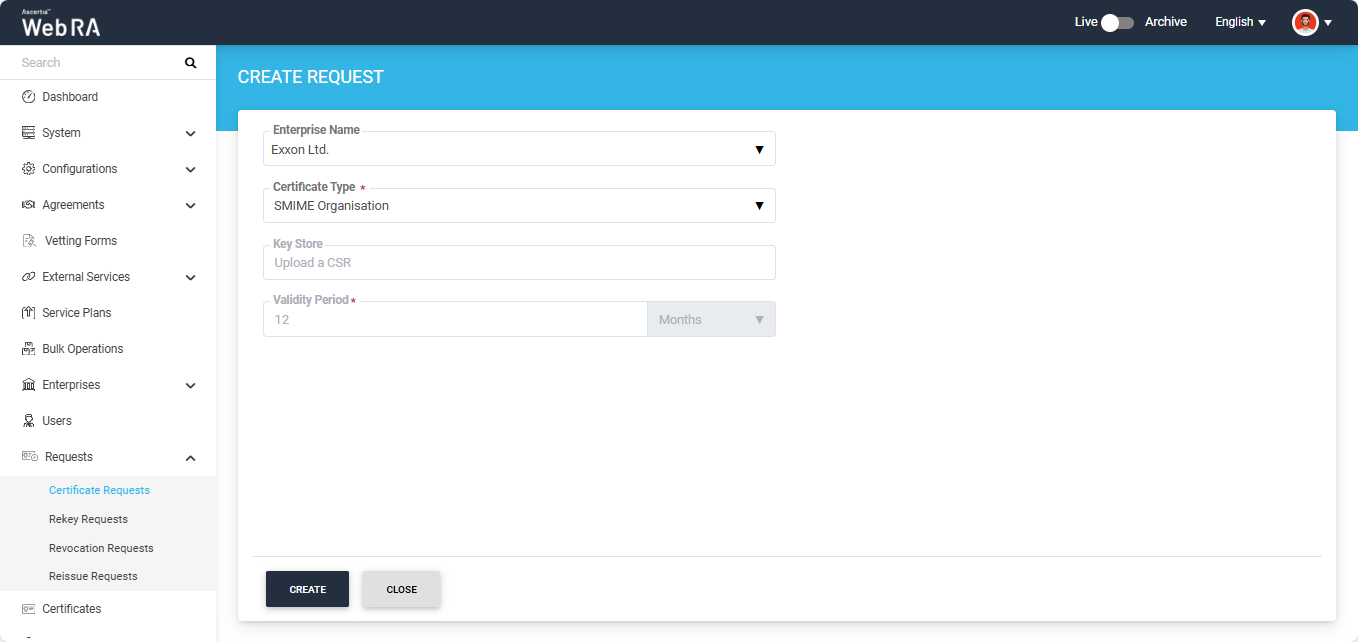
The system will display the Certificate Signing Request (CSR) screen. Here, you can either upload a CSR or paste it into the ‘Paste Certificate Signing Request (CSR)’ box.
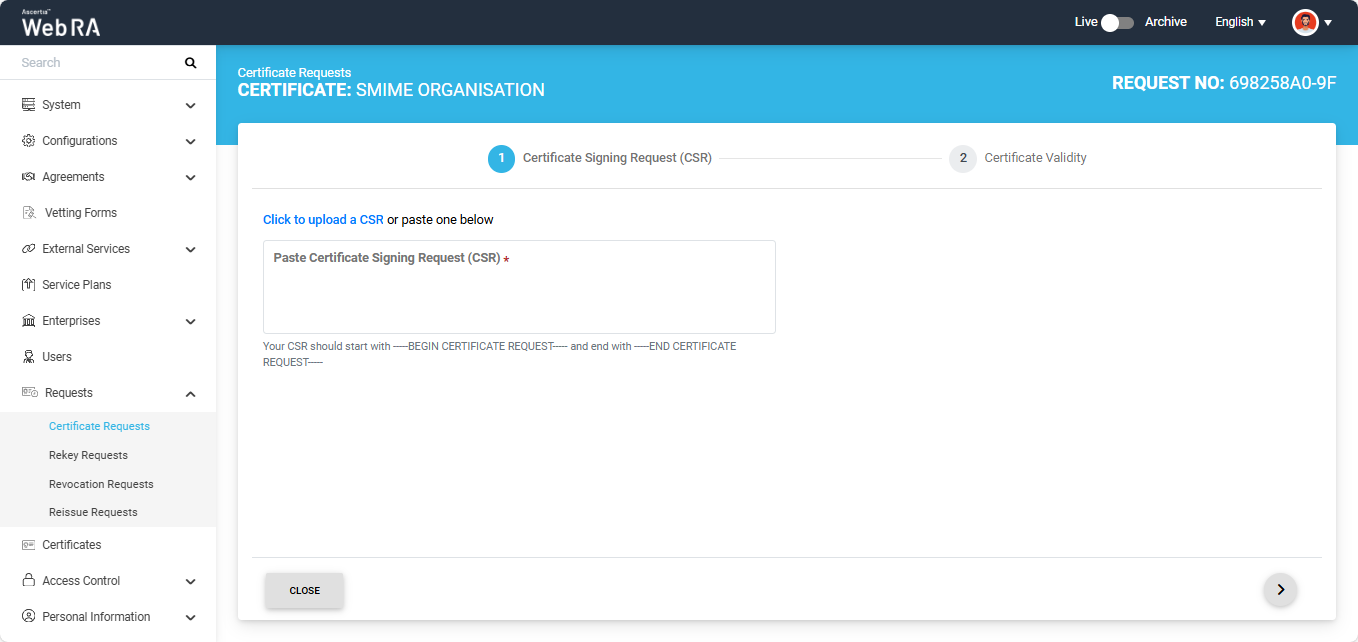
Once the CSR is uploaded, it will appear in the CSR field.
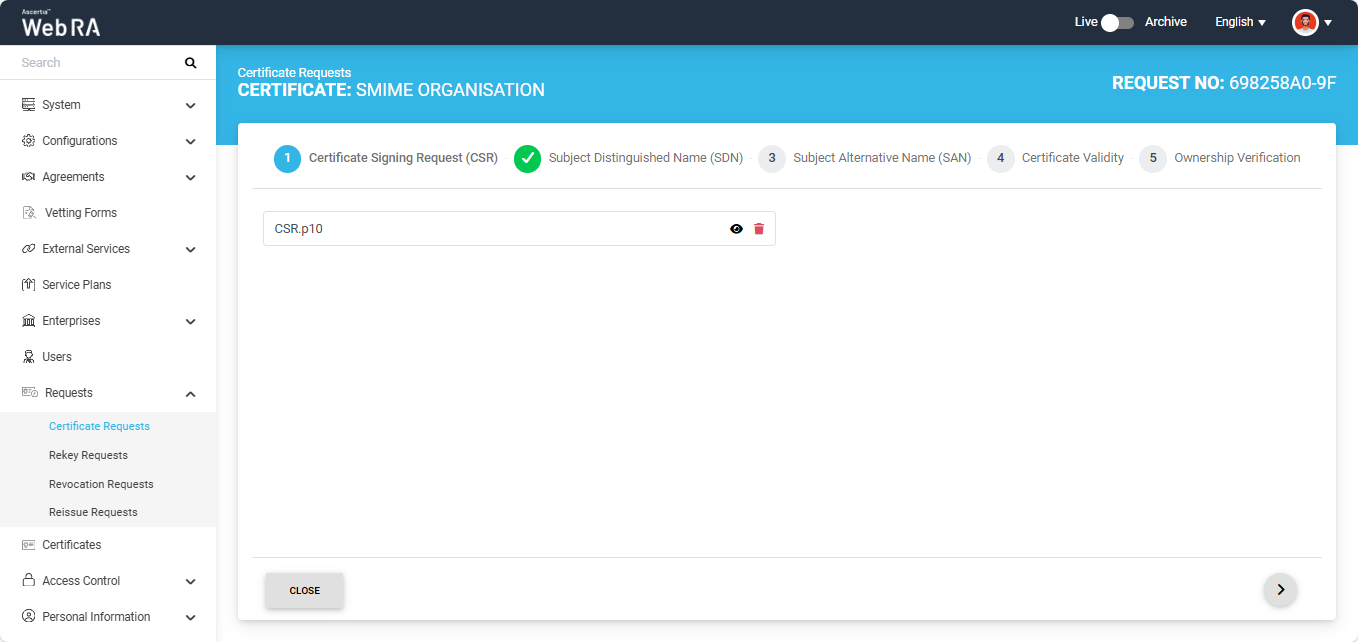
You can view the details of the CSR by clicking the Eye icon. It contains all the SDNs, SANs, etc.
Click the next '>' button to navigate to the 'Subject Distinguished Name (SDN)' screen. Here, review or update the information in the fields as required, then click the next ‘>’ button to proceed.
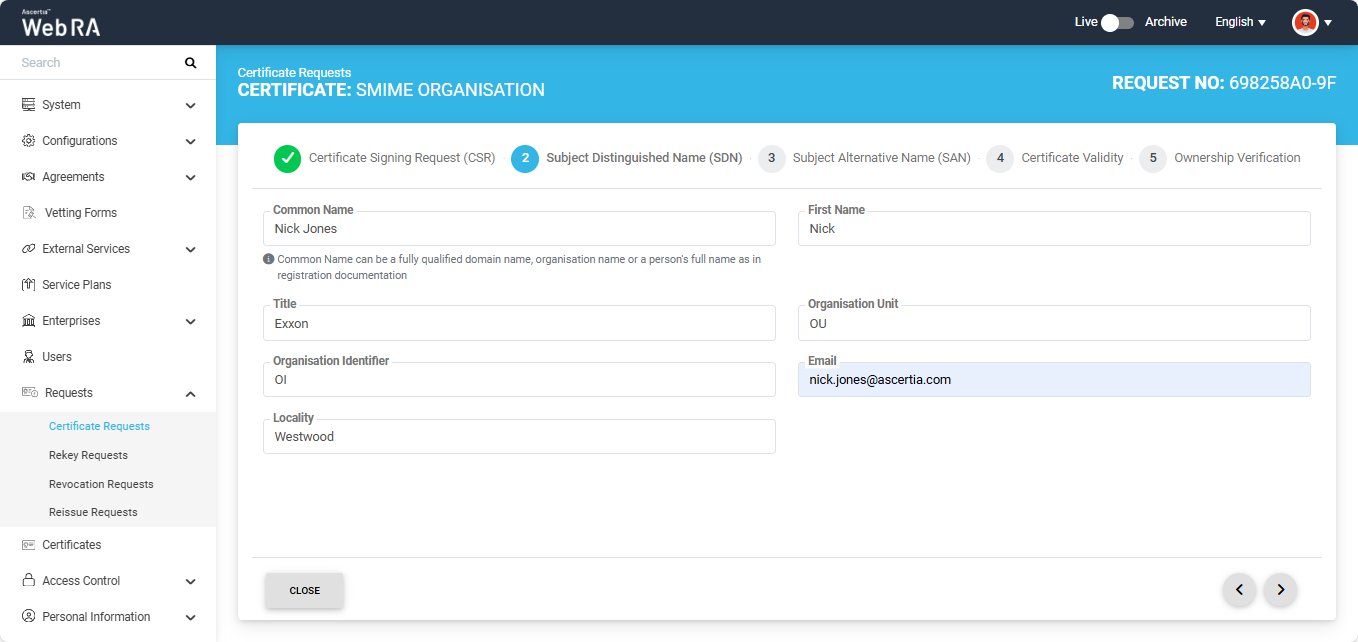
The Subject Alternative Name (SAN) screen will appear. Here, review or update the information in the fields as required.
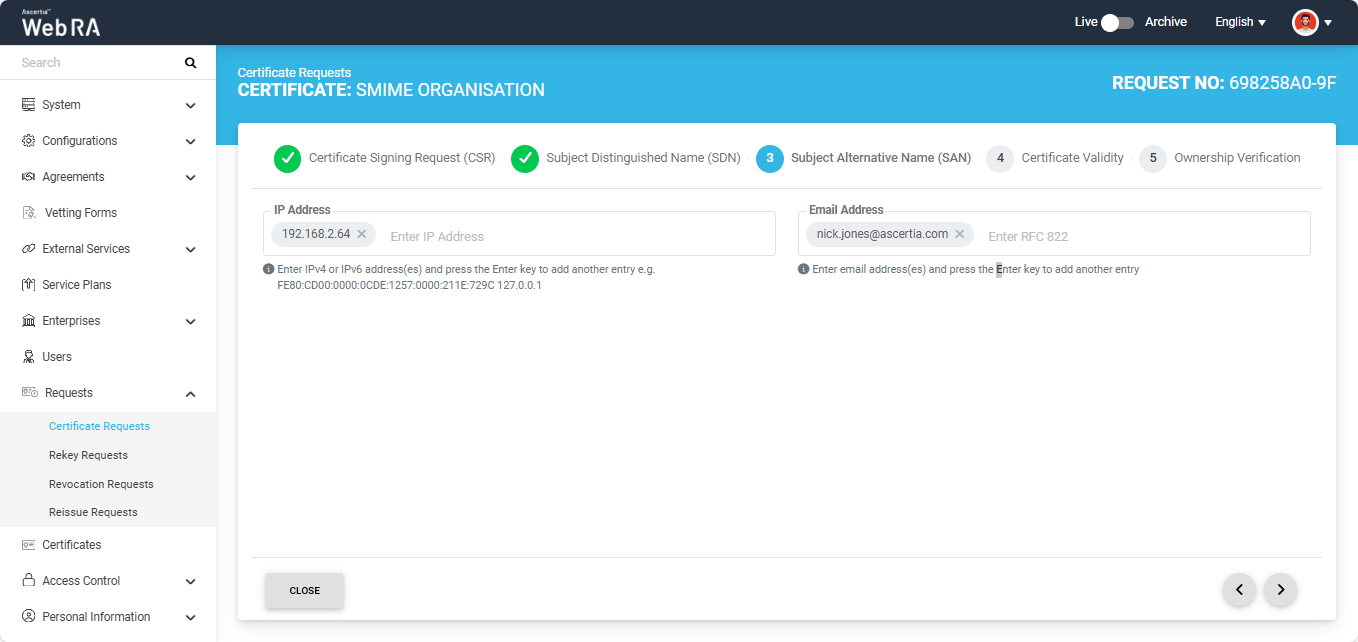
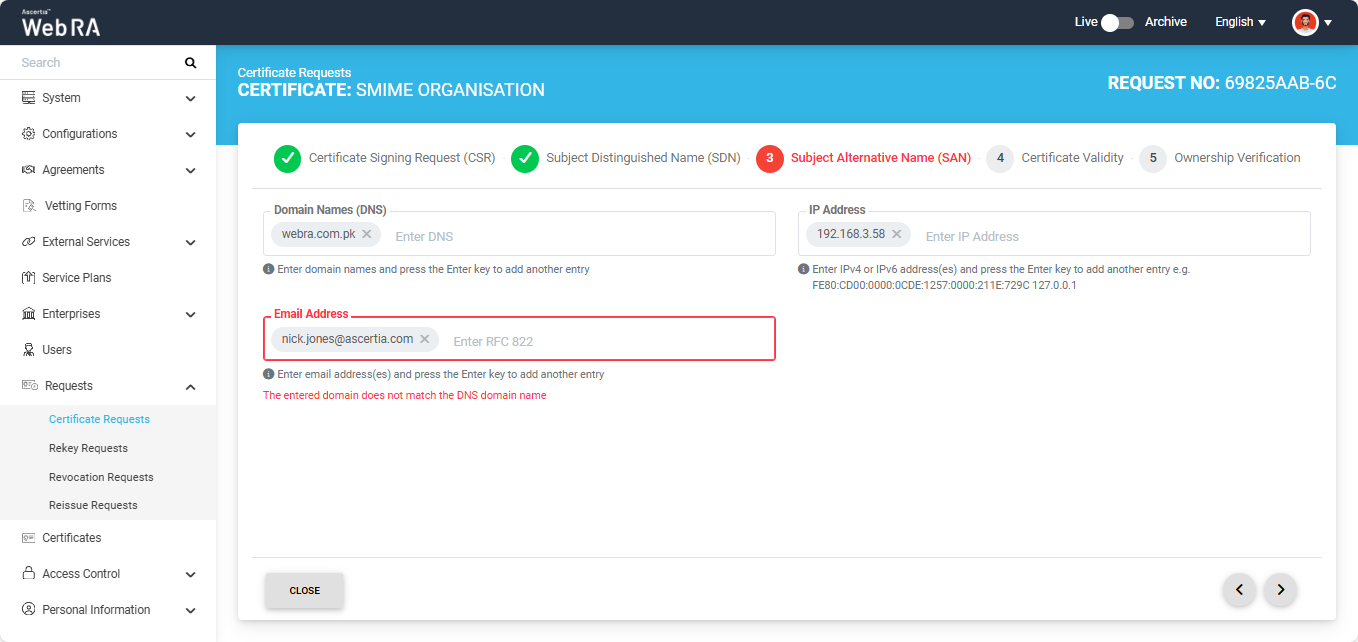
Note: If the Domain Names (DNS) field is present in the SAN, ensure that the domain in the DNS and Email Address fields are the same. If the domains differ, the system displays an error and does not allow you to proceed.
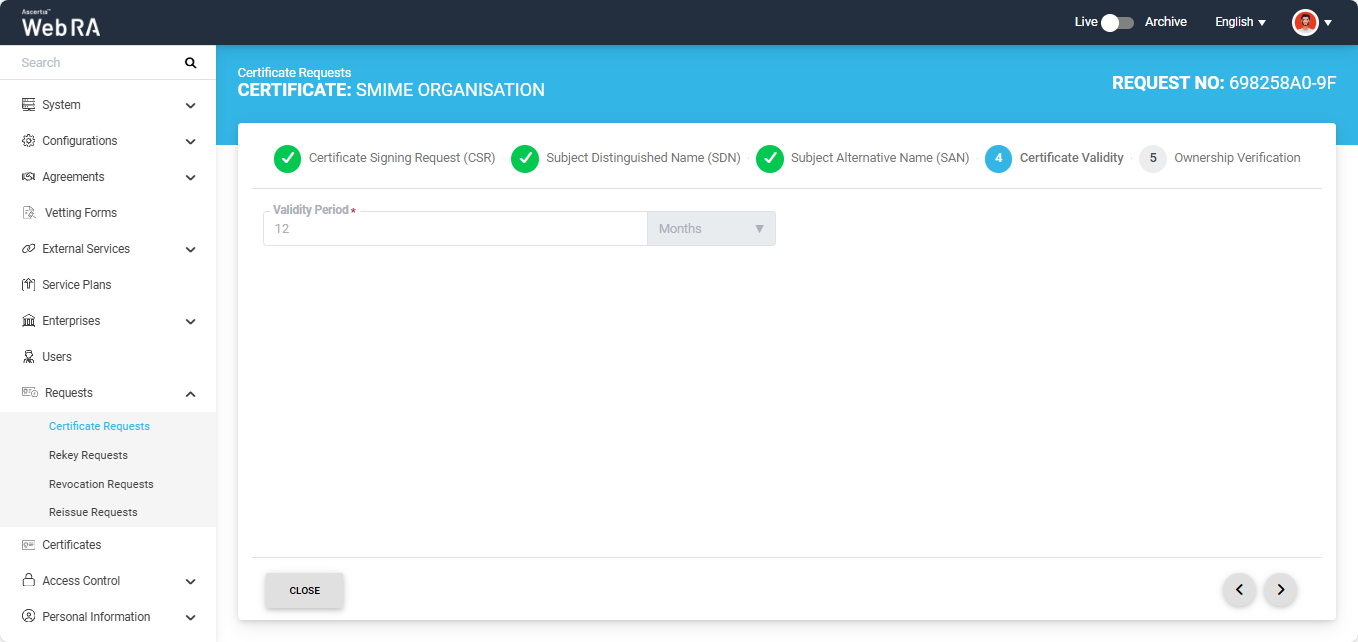
After completing the SAN section click the next ‘>’ button to proceed. The 'Certificate Validity' screen will appear.
Click the next '>' button to navigate to the 'Ownership Verification' screen. The system will display the 'Domain Verification' section on the screen. If the ‘Organisation’ validation type is configured in the certification profile, the ownership verification screen will require you to complete domain verification.
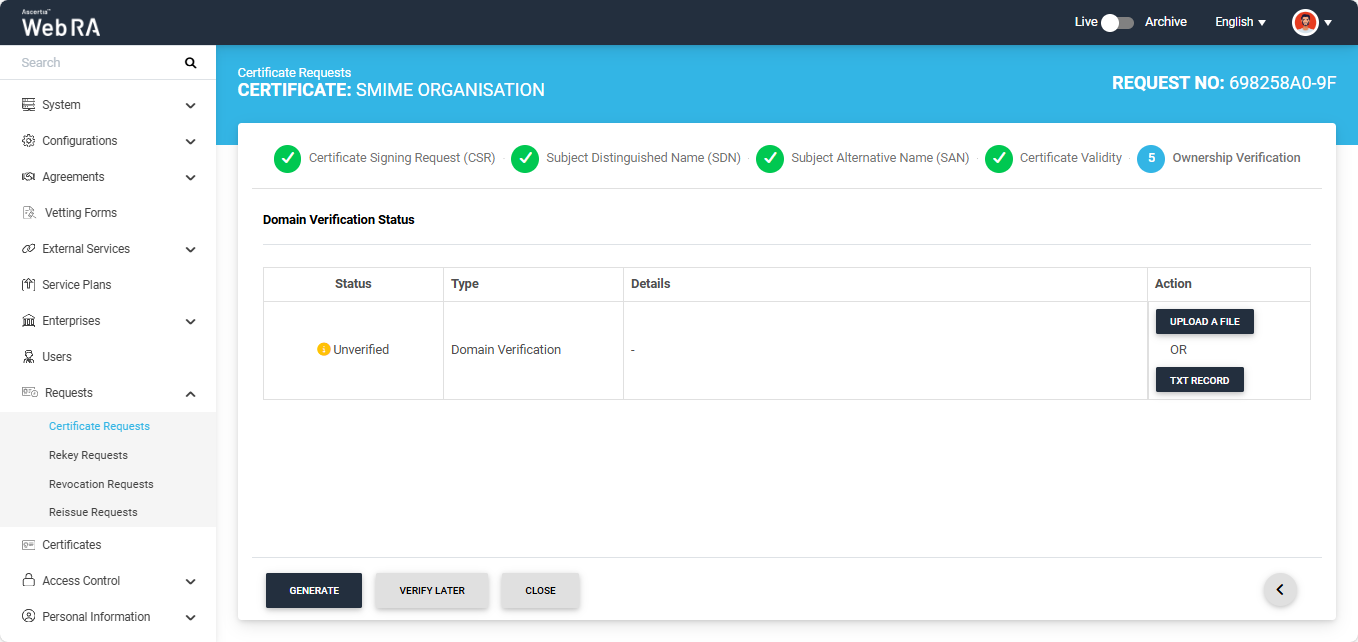
For domain verification, the system extracts the organisation domain from the email address in the RFC822Name field. If the Domain Names (DNS) field is present in the SAN, the system matches the domain in the DNS field with the domain in the RFC822Name field. The system will match the domain in the SAN section, as mentioned in the steps above.
Domain verification can be performed either by uploading a file or by adding a TXT record.
Note: The action (Upload a File or TXT Record) through which domain verification can be performed is configured in the certification profile. The operator may select one or both methods for domain verification. You can use any of the method to verify your domain. For more details about how the method is selected, navigate to the ‘Certification Profiles’ section.
Upload a File
Click the ‘Upload a File’ button. The system will display the ‘Upload a File’ dialog, which contains instructions on how to verify the domain using this method.
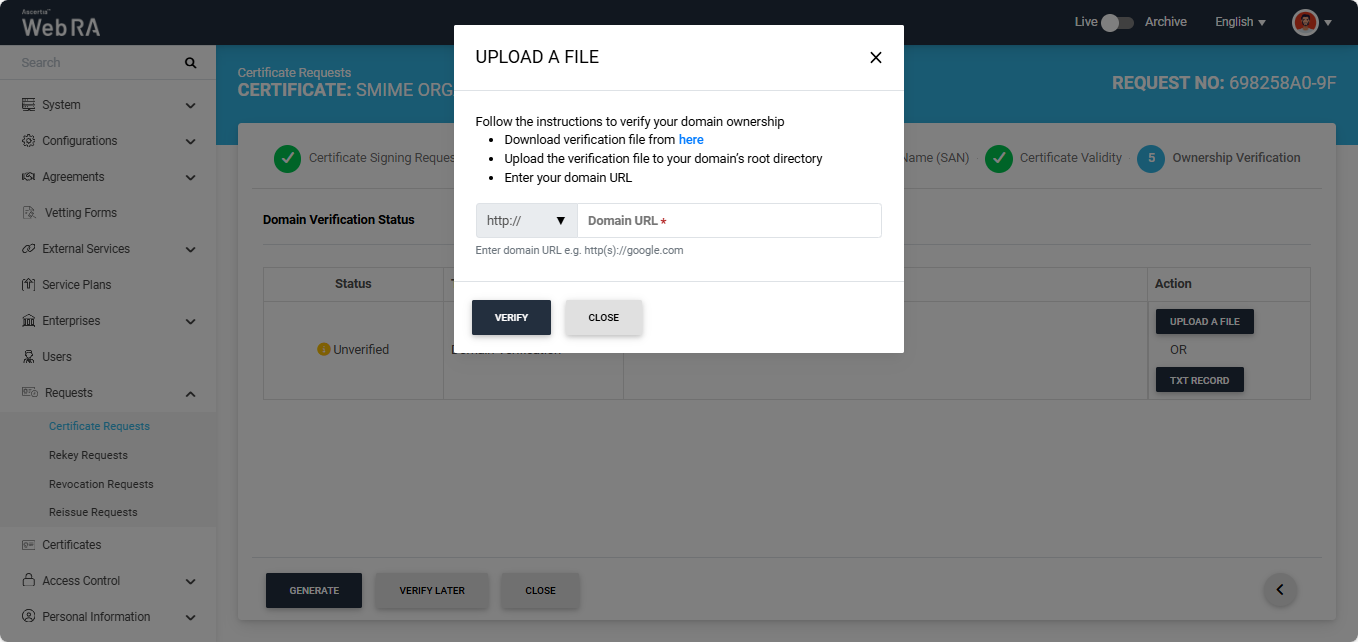
Follow the instructions in the dialog and click ‘Verify’. If all steps are completed correctly, the ‘Verified’ status will appear for the entered domain.
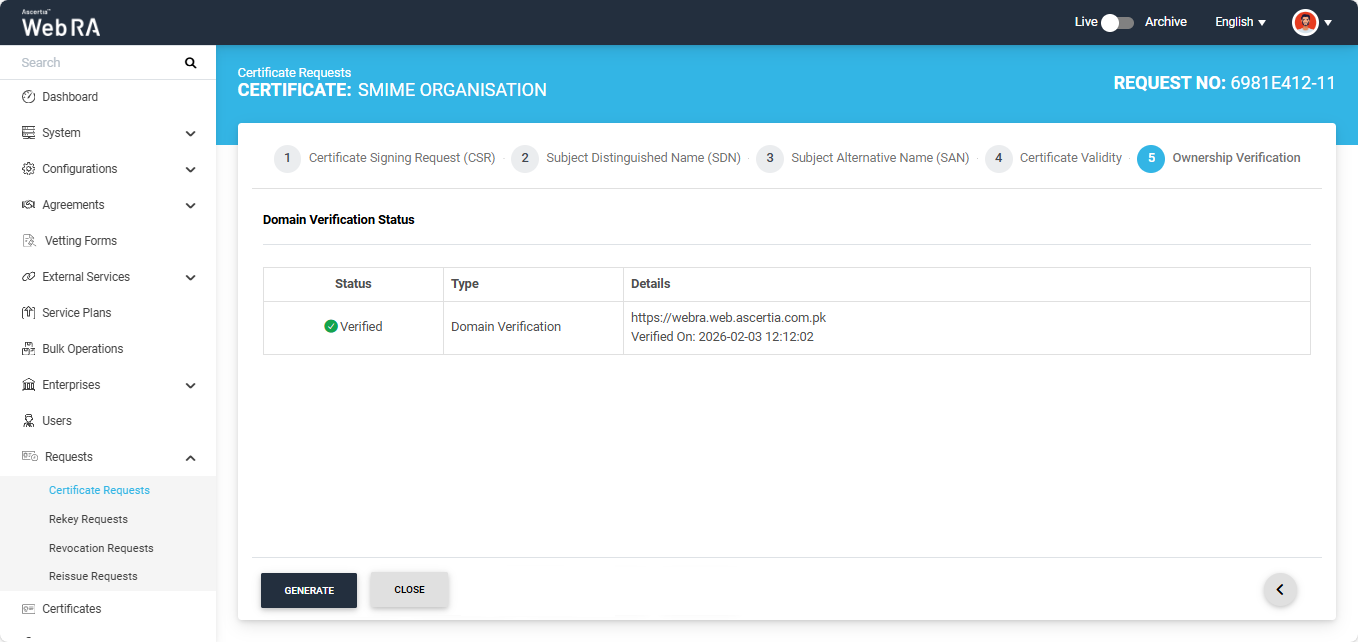
After the verification is complete you can click the generate button to create the certificate.
TXT Record
Click the ‘TXT Record’ button. The system will display the ‘TXT Record’ dialog, which contains instructions on how to verify the domain using this method.
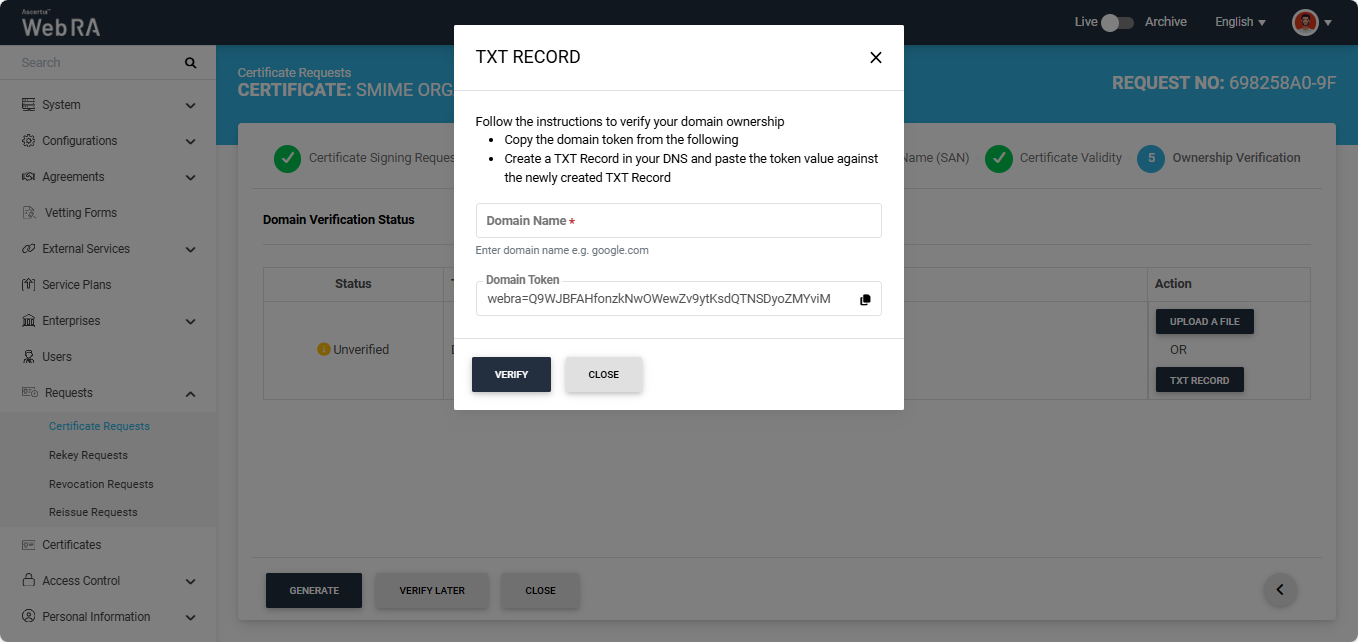
Follow the instructions in the dialog and click ‘Verify’. If all steps are completed correctly, the ‘Verified’ status will appear for the entered domain.
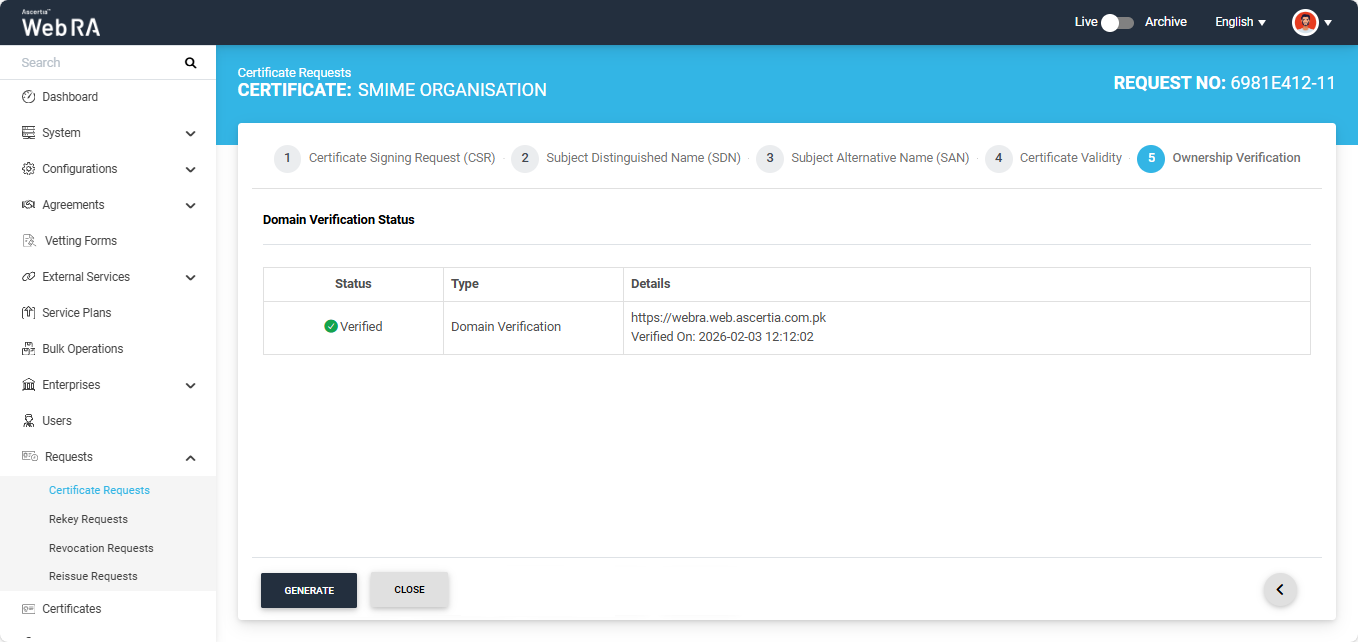
After the verification is complete you can click the generate button to create the certificate.
Note: If Certification Authority Authorisation (CAA) Records is enabled in the Enterprise Domain Settings, CAA record verification is required in the Ownership Verification section. When CAA record verification is enabled and the Organisation validation type is selected, the system performs both domain verification and CAA record verification before generating the certificate. Ensure that the domain in the DNS and Email Address fields of the SAN are the same. If they differ, the system displays an error on the SAN screen and does not allow you to proceed. For more details, see how CAA Record Verification is performed.
S/MIME certificate requests with Sponsor validation type
The following steps describe how to create an S/MIME certificate request with the Sponsor validation type.
Expand Requests > Certificate Requests from the Admin portal to navigate to the Certificate Requests listing screen.
Click the + button in the grid header to access the Create Request screen. Select the Enterprise name from the dropdown, choose the Certificate Type, and click 'Create'.
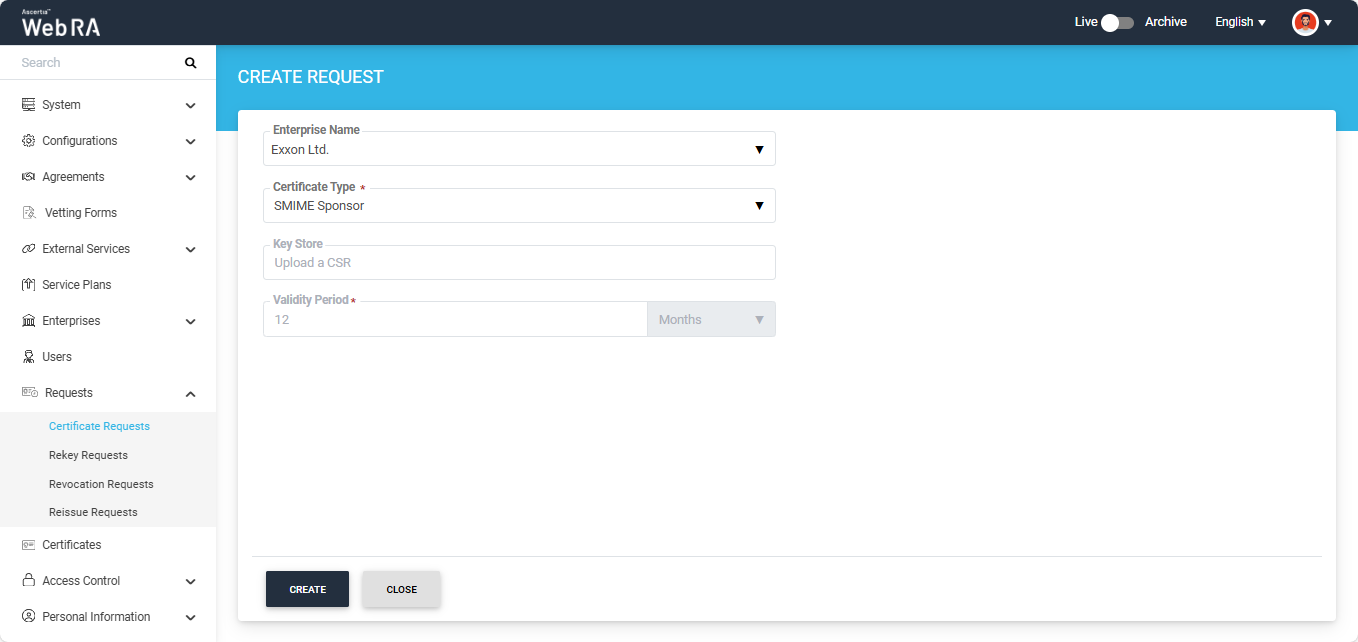
The system will display the Certificate Signing Request (CSR) screen. Here, you can either upload a CSR or paste it into the ‘Paste Certificate Signing Request (CSR)’ box.
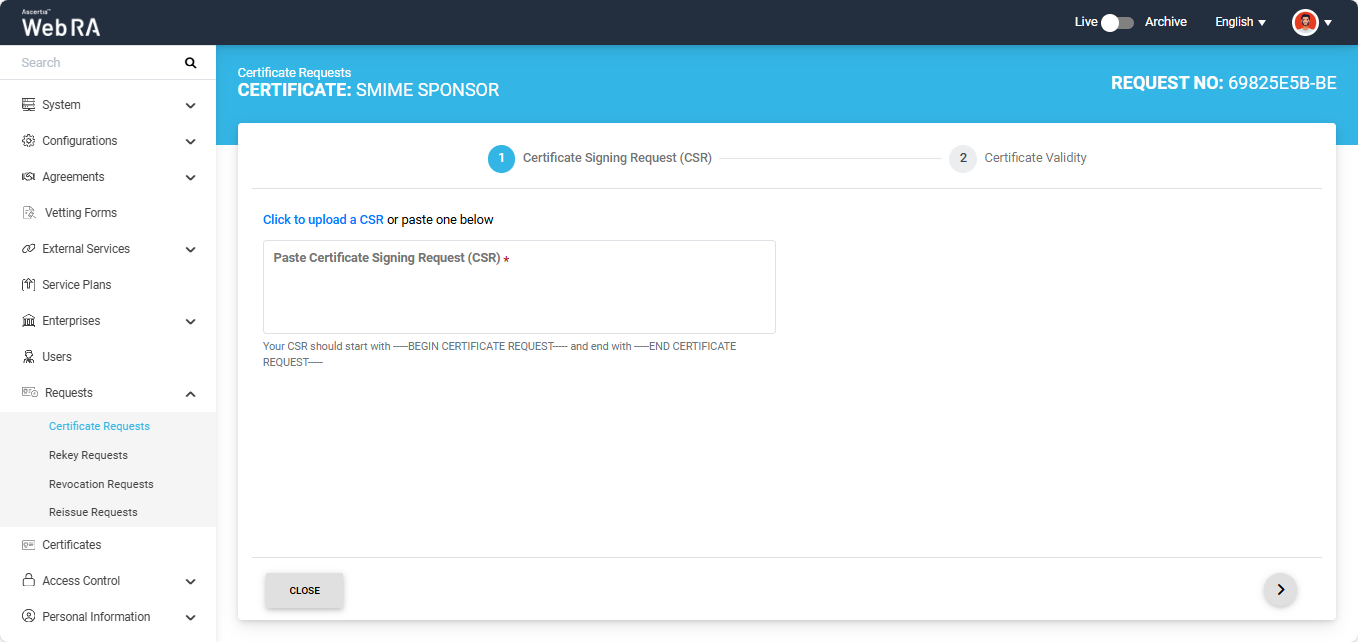
Once the CSR is uploaded, it will appear in the CSR field. You can view the details of the CSR by clicking the Eye icon. It contains all the SDNs, SANs, etc.
Click the next '>' button to navigate to the 'Subject Distinguished Name (SDN)' screen. Here, review or update the information in the fields as required, then click the next ‘>’ button to proceed.
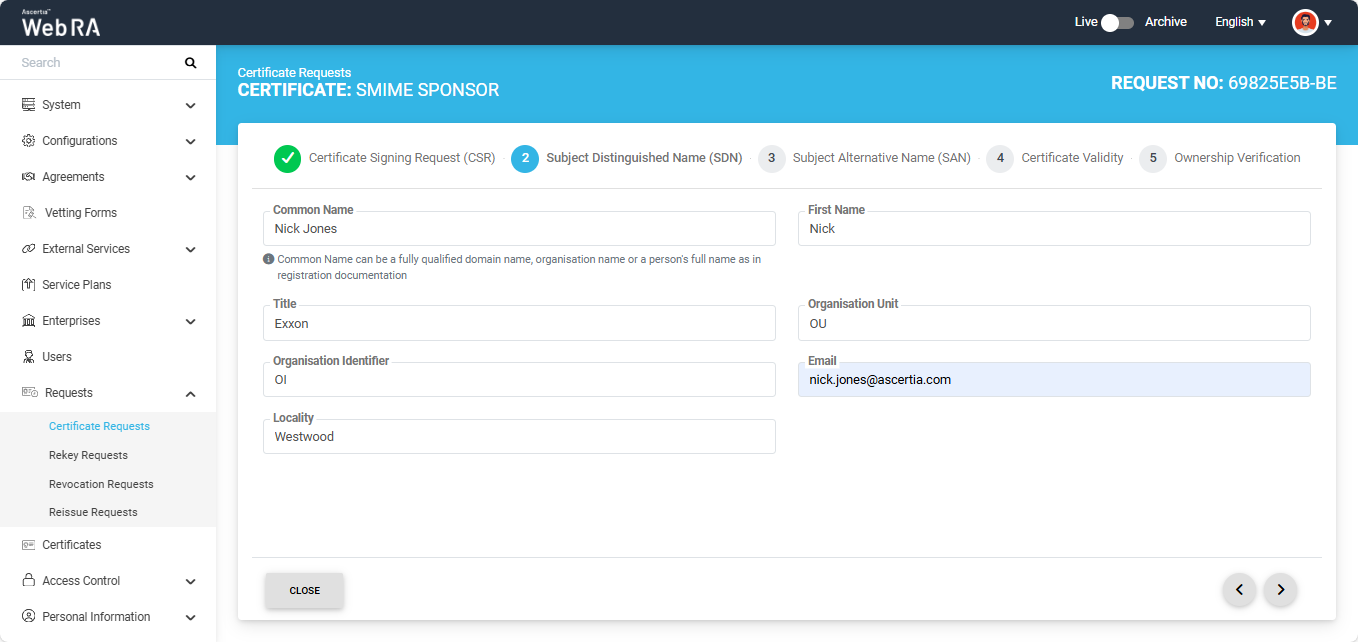
The Subject Alternative Name (SAN) screen will appear. Here, review or update the information in the fields as required.
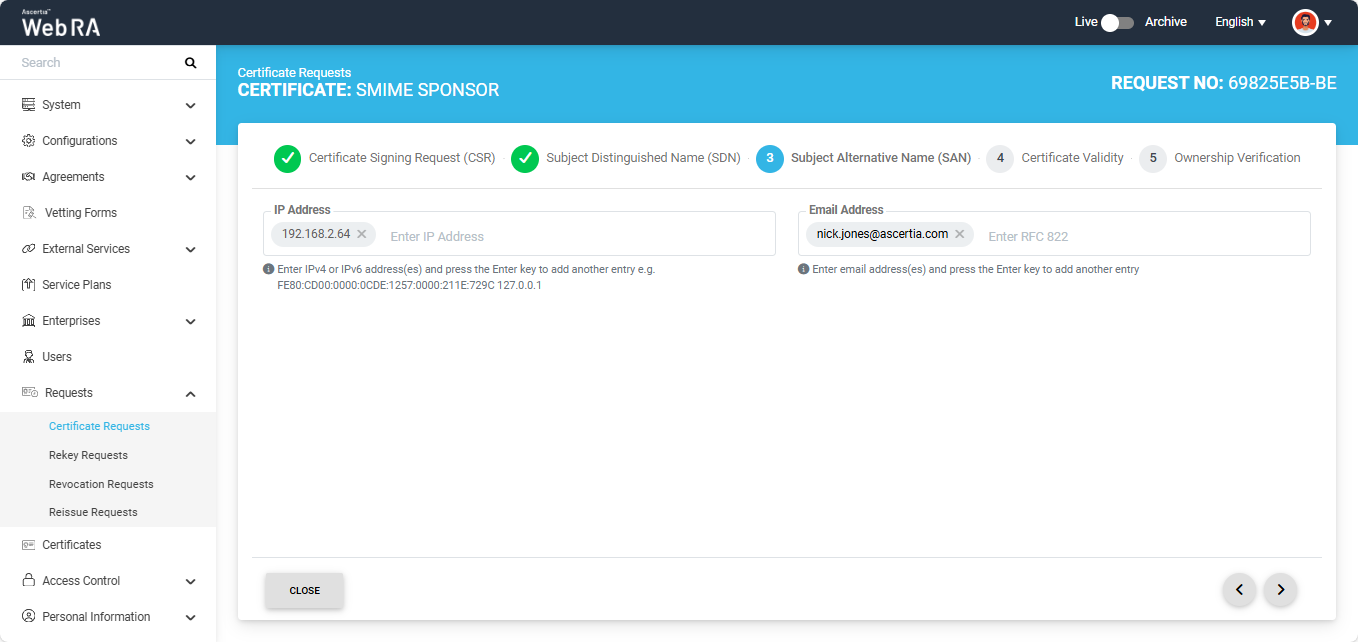
Note: If the Domain Names (DNS) field is present in the SAN, ensure that the domain in the DNS and Email Address fields are the same. If the domains differ, the system displays an error and does not allow you to proceed.
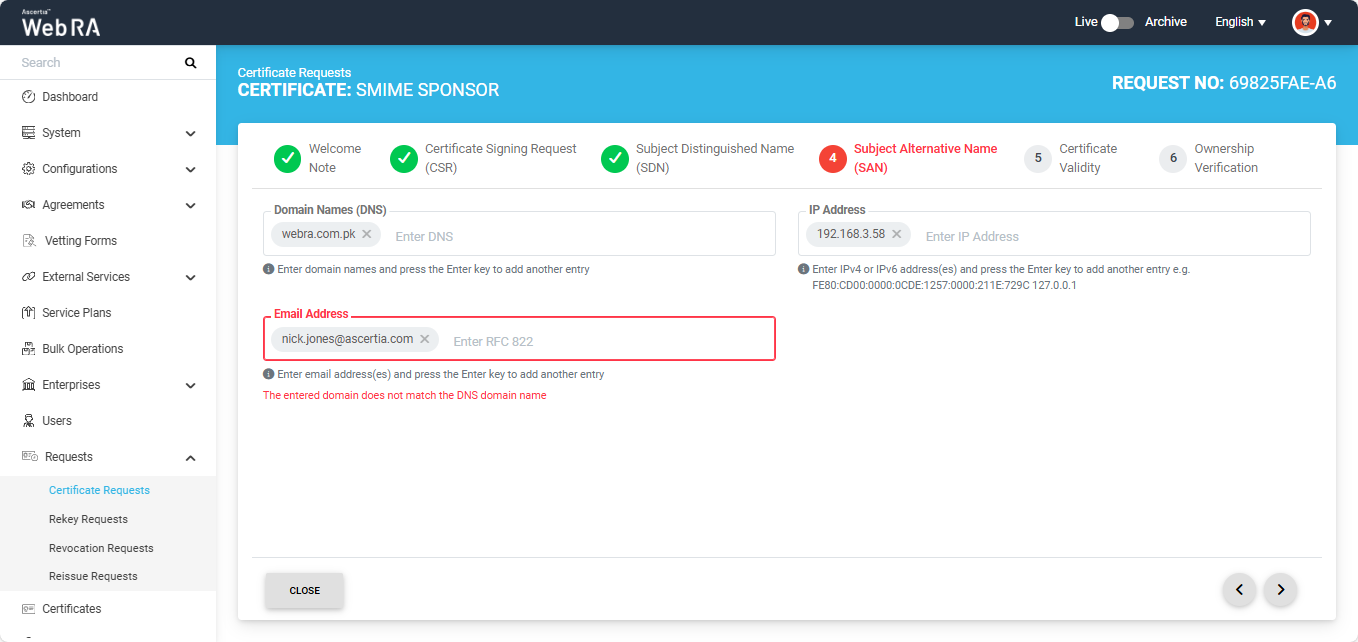
After completing the SAN section click the next ‘>’ button to proceed. The 'Certificate Validity' screen will appear.
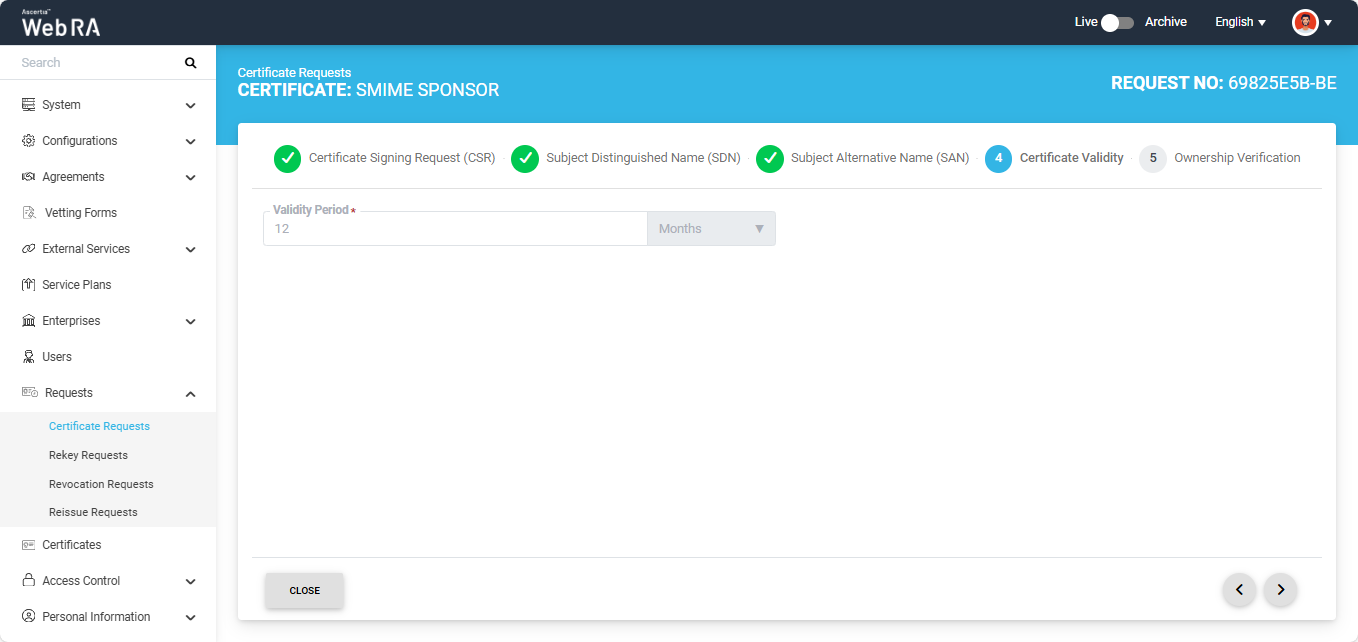
Click the next '>' button to navigate to the 'Ownership Verification' screen. The system will display the Email Validation and the Domain Verification sections on the screen. If the ‘Sponsor’ validation type is configured in the certification profile, the ownership verification screen will require you to complete both verifications before generating the certificate.
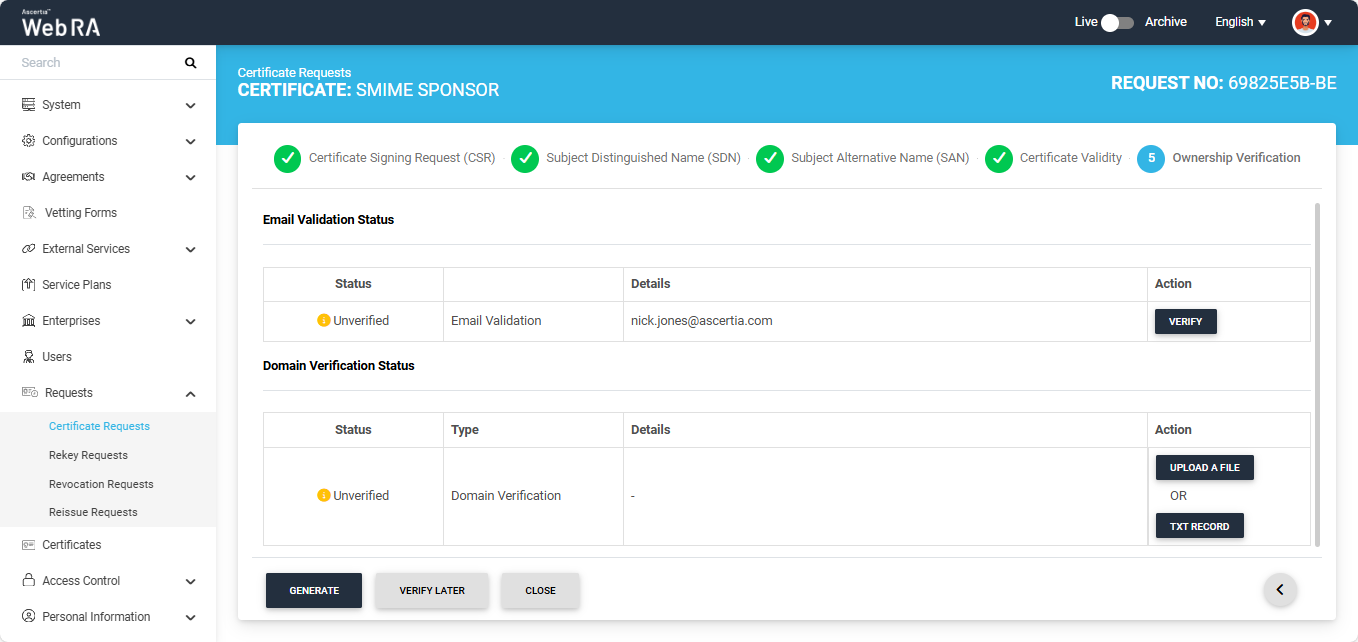
For domain verification, the system extracts the organisation domain from the email address in the RFC822Name field. If the Domain Names (DNS) field is present in the SAN, the system matches the domain in the DNS field with the domain in the RFC822Name field. The system will match the domain in the SAN section, as mentioned in the steps above.
Domain verification can be performed either by uploading a file or by adding a TXT record.
Note: The action (Upload a File or TXT Record) through which domain verification can be performed is configured in the certification profile. The operator may select one or both methods for domain verification. You can use any of the method to verify your domain. For more details about how the method is selected, navigate to the ‘Certification Profiles’ section.
Email Validation
To verify the email address, click the ‘Verify’ button in the Action column. An ‘Email Validation’ dialog will appear on the screen, and a Token will be sent to the specified email address.
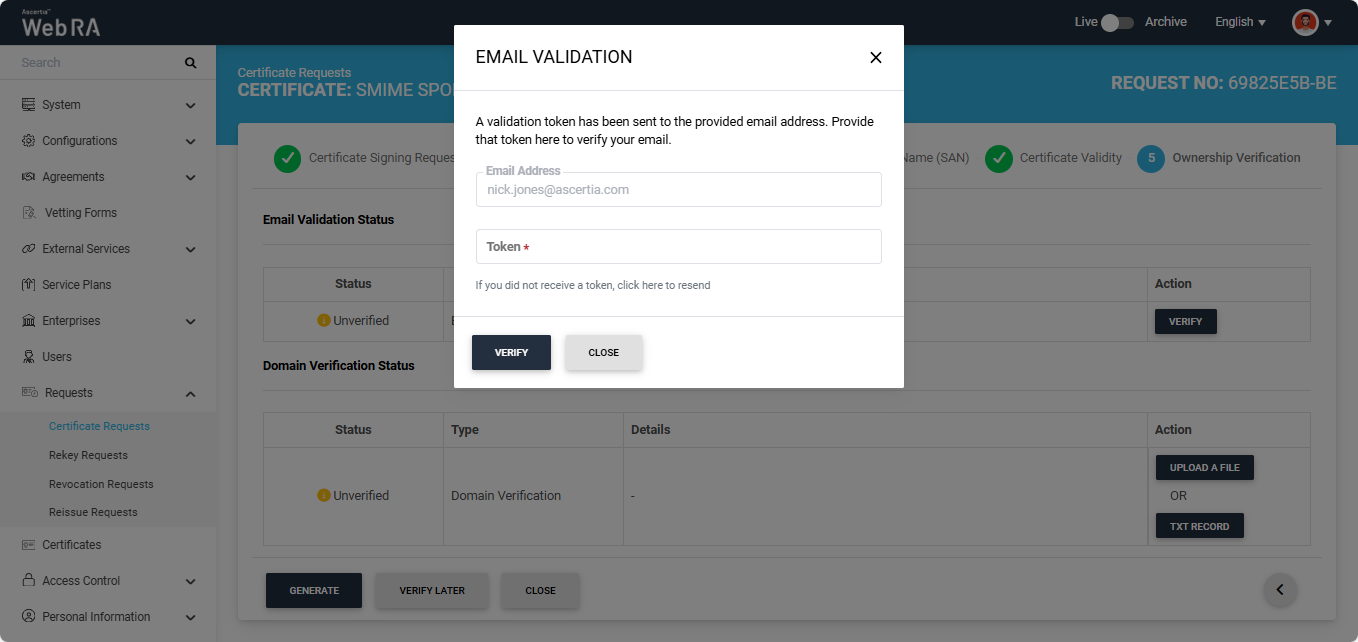
Enter the token you received in your email in the ‘Token’ field, then click ‘Verify’. If the provided token is correct, the system will display the ‘Verified’ status for the email address.
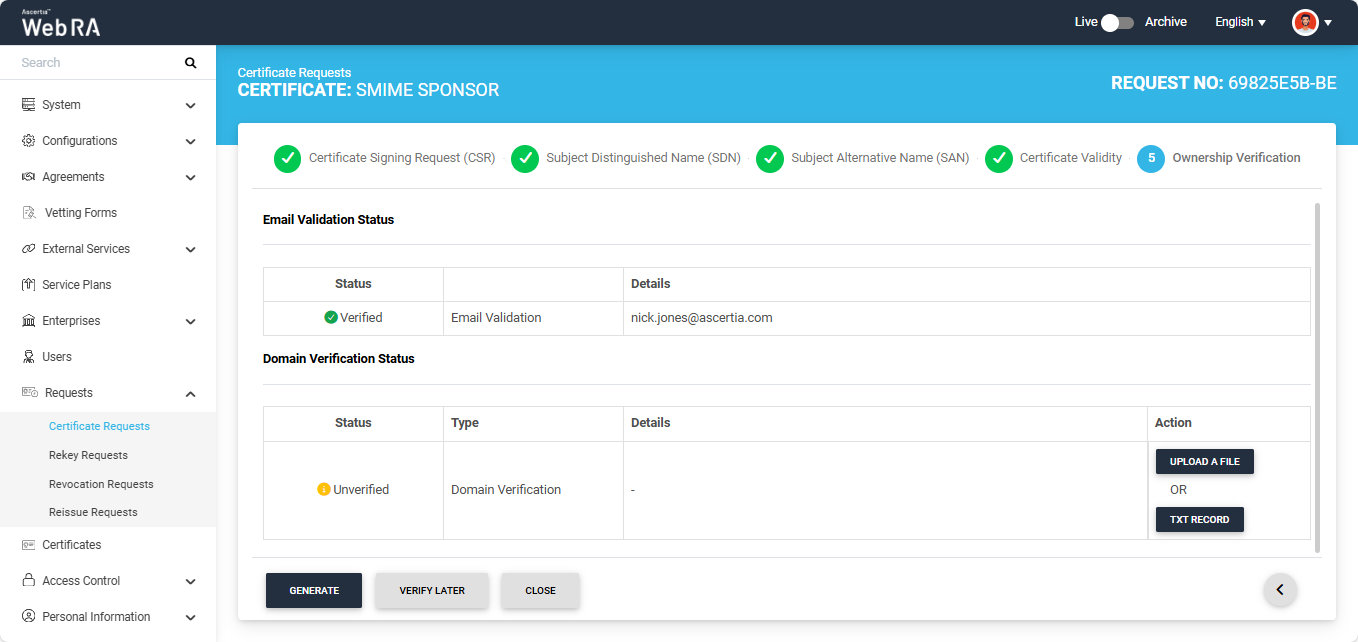
After verifying the email address, you must verify the domain. The steps for verifying the domain - either by uploading a file or by adding a TXT record - are provided below.
Upload a File
Click the ‘Upload a File’ button. The system will display the ‘Upload a File’ dialog, which contains instructions on how to verify the domain using this method.
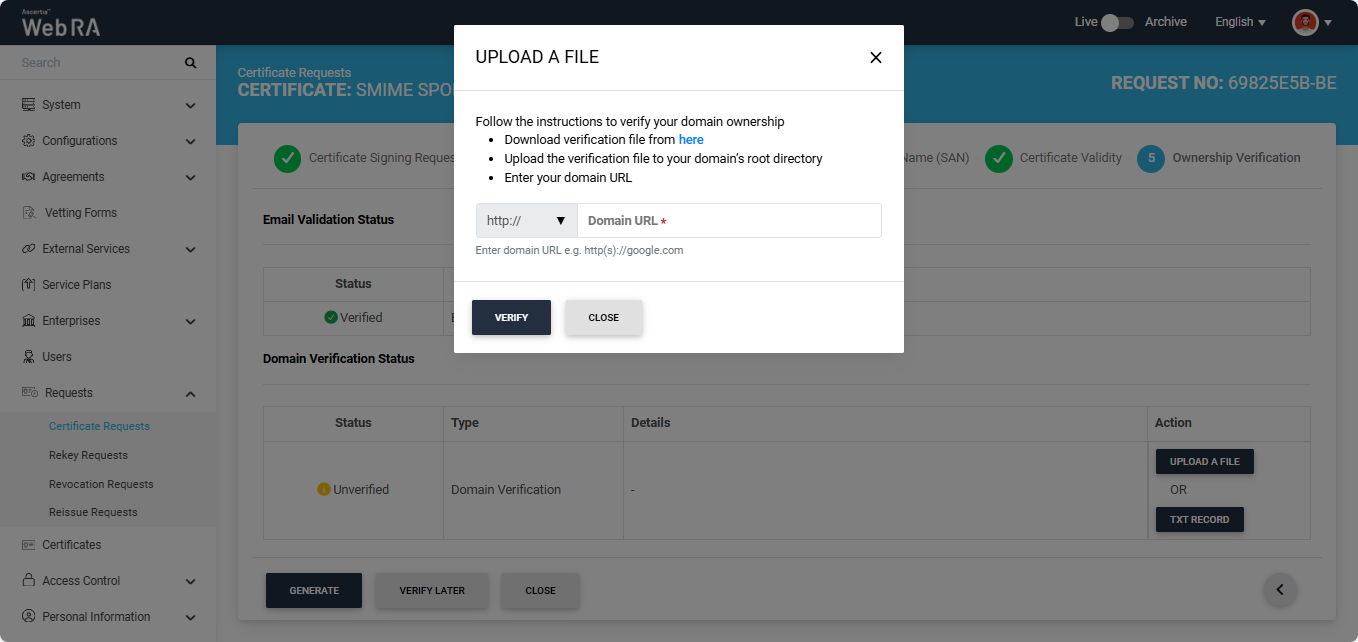
Follow the instructions in the dialog and click ‘Verify’. If all steps are completed correctly, the ‘Verified’ status will appear for the entered domain.
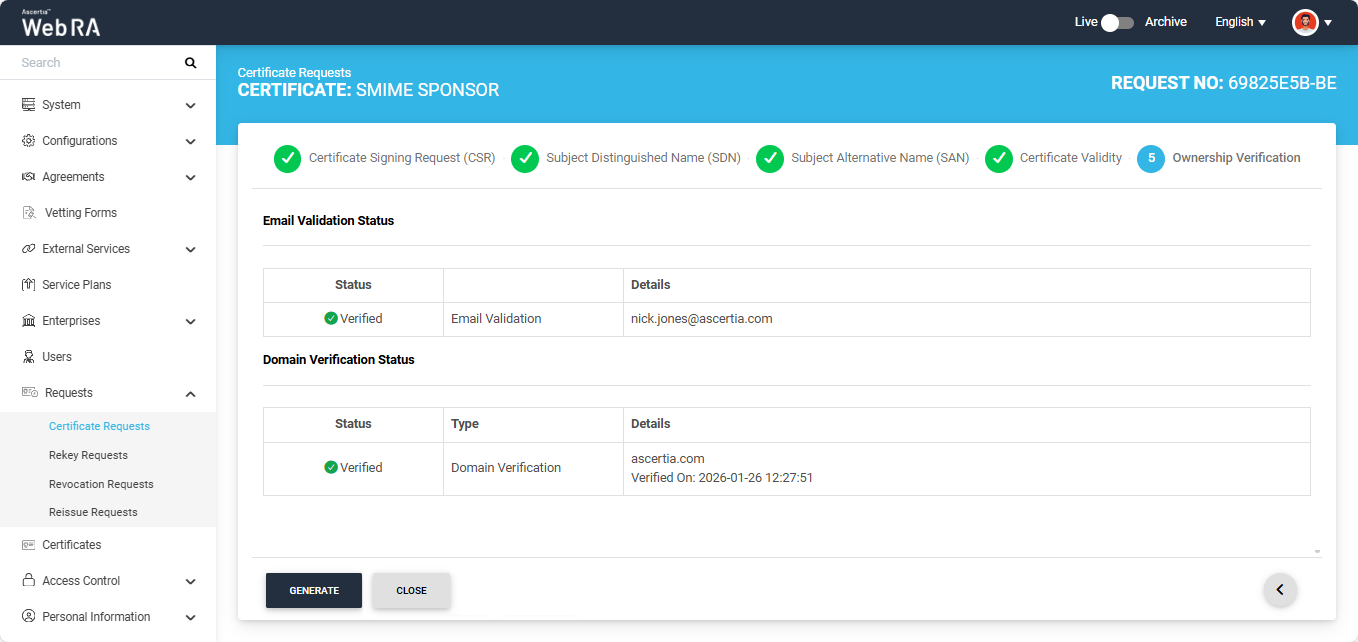
After the verification is complete you can click the generate button to create the certificate.
TXT Record
Click the ‘TXT Record’ button. The system will display the ‘TXT Record’ dialog, which contains instructions on how to verify the domain using this method.
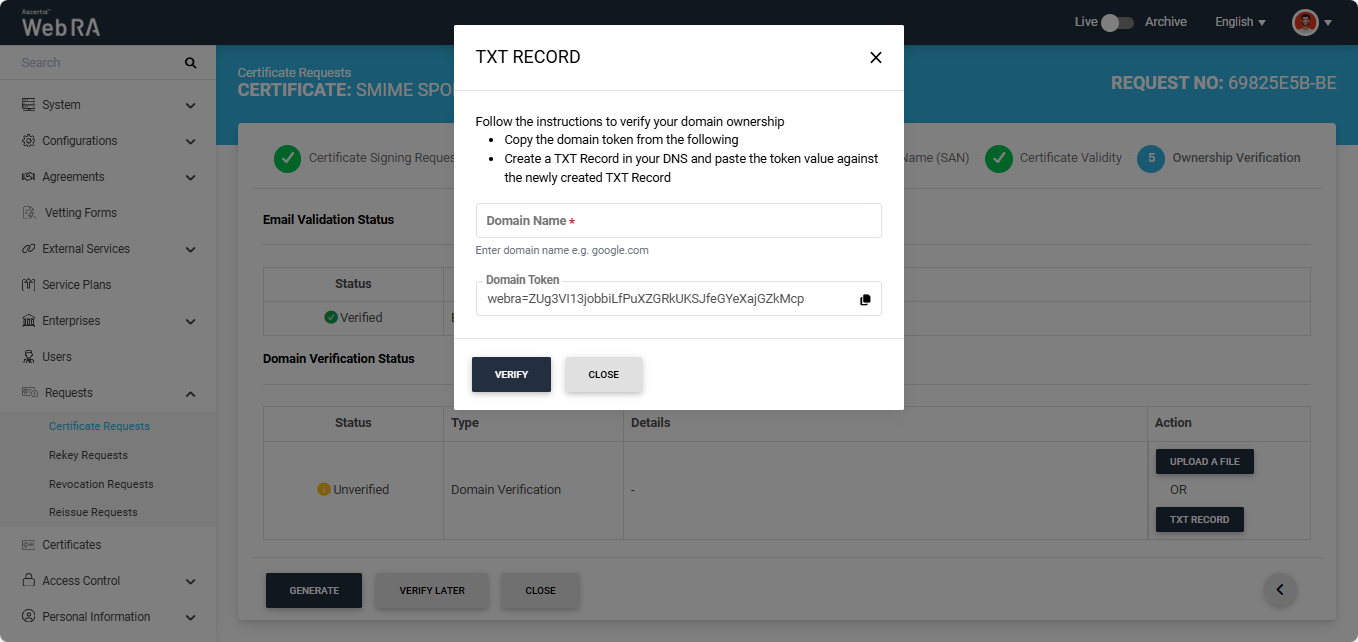
Follow the instructions in the dialog and click ‘Verify’. If all steps are completed correctly, the ‘Verified’ status will appear for the entered domain.
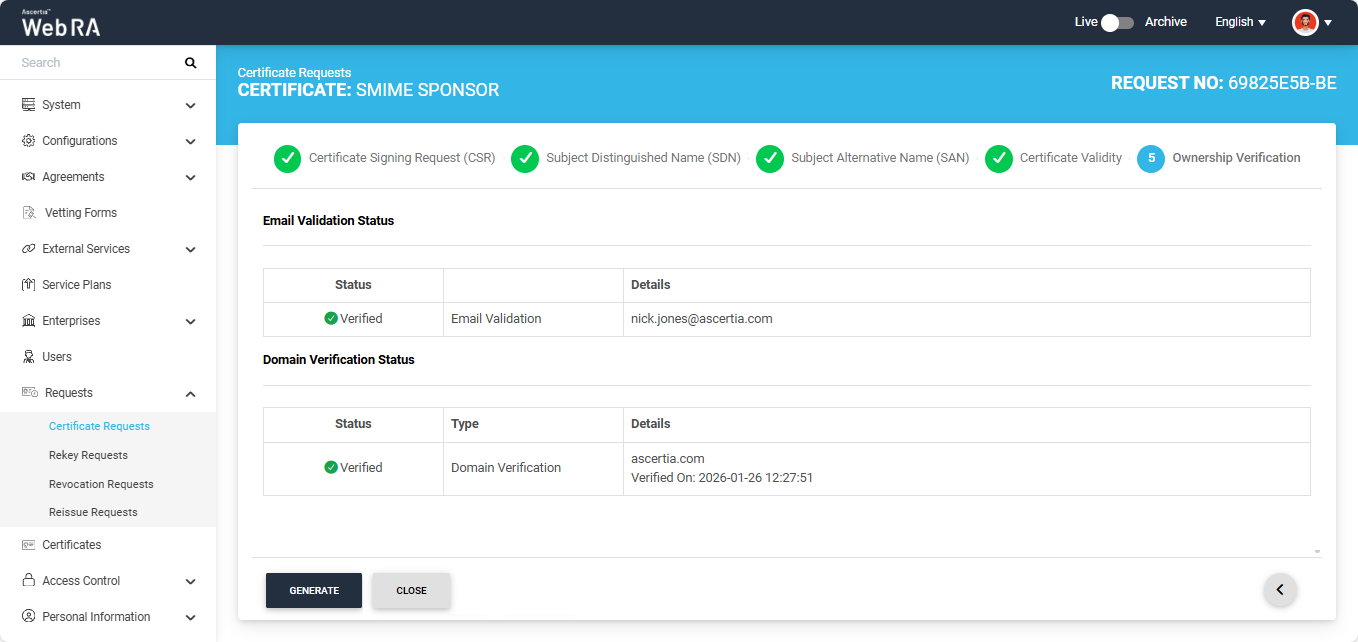
After the verification is complete you can click the generate button to create the certificate.
Note: If Certification Authority Authorisation (CAA) Records is enabled in the Enterprise Domain Settings, CAA record verification is required in the Ownership Verification section. When CAA record verification is enabled and the Sponsor validation type is selected, the system performs email validation, domain verification and CAA record verification before generating the certificate. Ensure that the domain in the DNS and Email Address fields of the SAN are the same. If they differ, the system displays an error on the SAN screen and does not allow you to proceed. For more details, see how CAA Record Verification is performed.
If Certification Authority Authorisation (CAA) Records is enabled in the Enterprise Domain Settings, CAA record verification is required in the Ownership Verification section.
The following steps describe how CAA record verification is performed during S/MIME certificate request creation.
Expand Requests > Certificate Requests from the Admin portal to navigate to the Certificate Requests listing screen.
Click the + button in the grid header to access the Create Request screen. Select the Enterprise name from the dropdown, choose the Certificate Type, and click 'Create'.
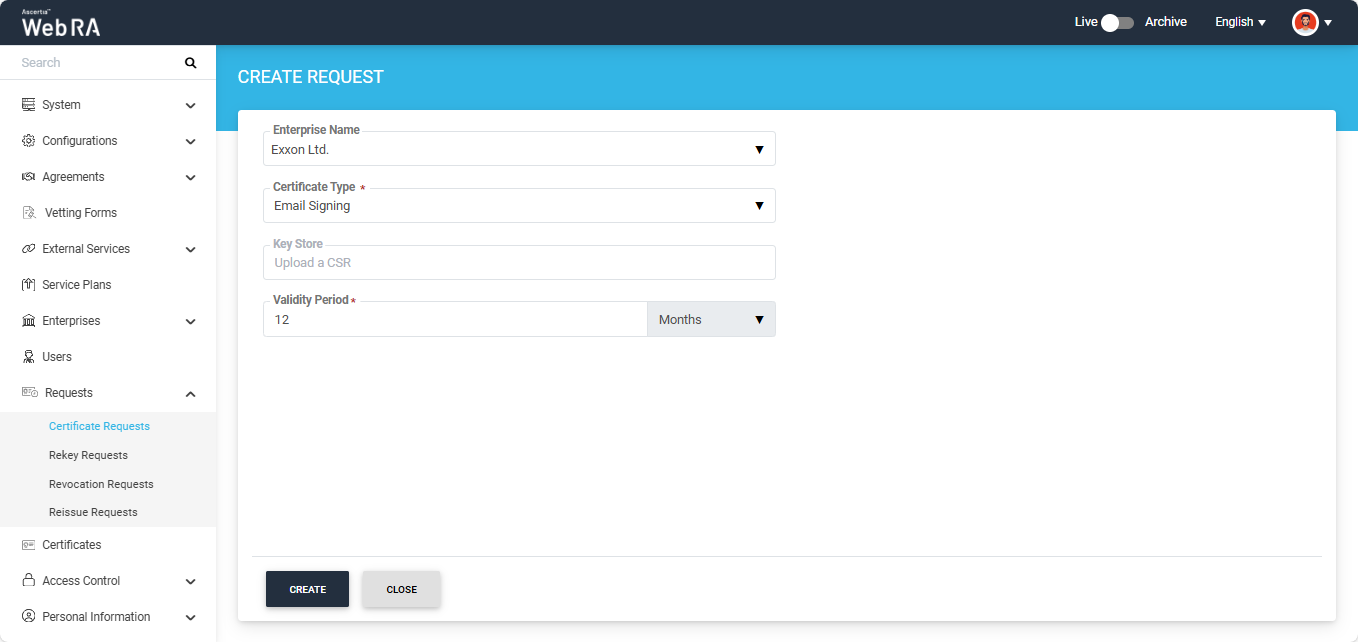
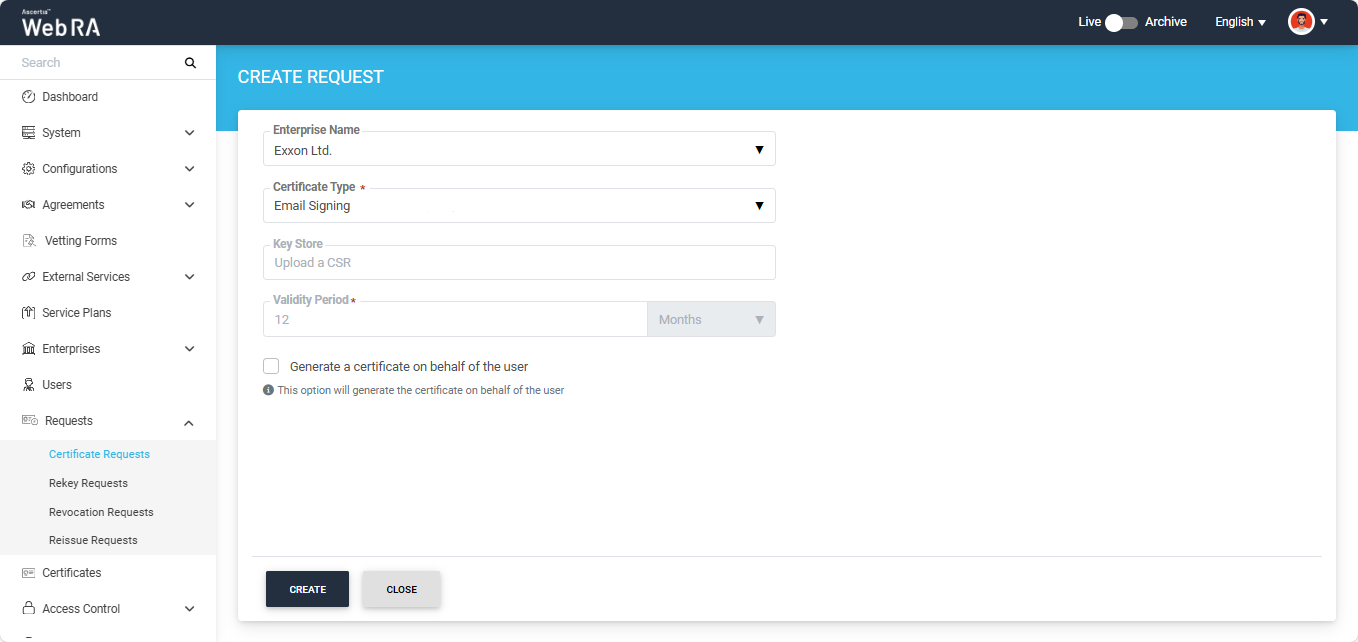
Note: A checkbox titled ‘Generate a certificate on behalf of the user’ will appear on this screen if the policy for this option is enabled in the Enterprise > Policies section.
The system will display the Certificate Signing Request (CSR) screen. Here, you can either upload a CSR or paste it into the ‘Paste Certificate Signing Request (CSR)’ box.
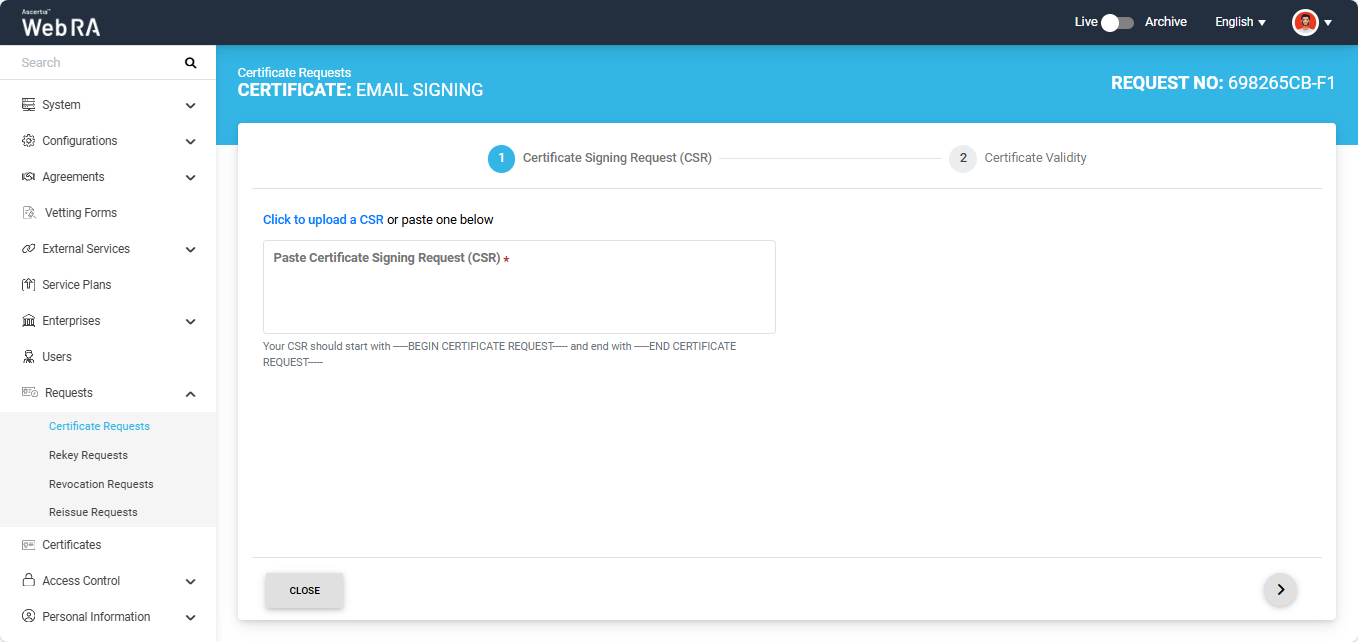
Once the CSR is uploaded, it will appear in the CSR field. You can view the details of the CSR by clicking the Eye icon.
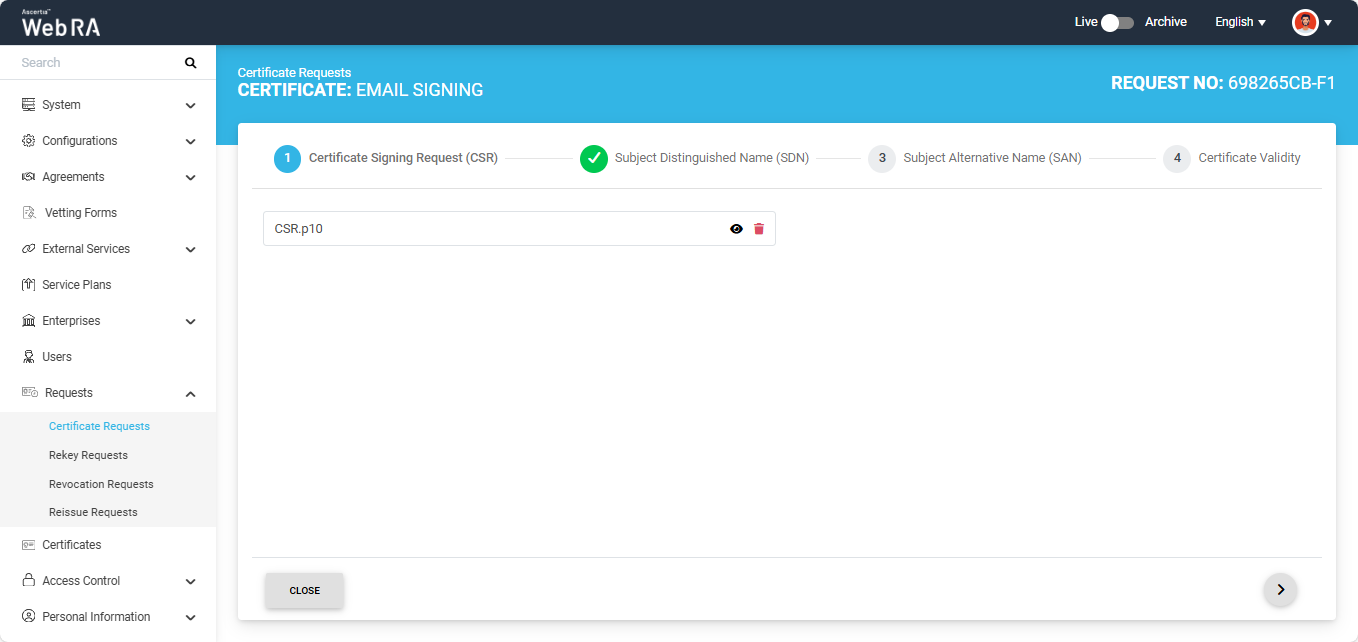
Click the next '>' button to navigate to the 'Subject Distinguished Name (SDN)' screen. Review or update the information in the fields as required, then click the next ‘>’ button to proceed.
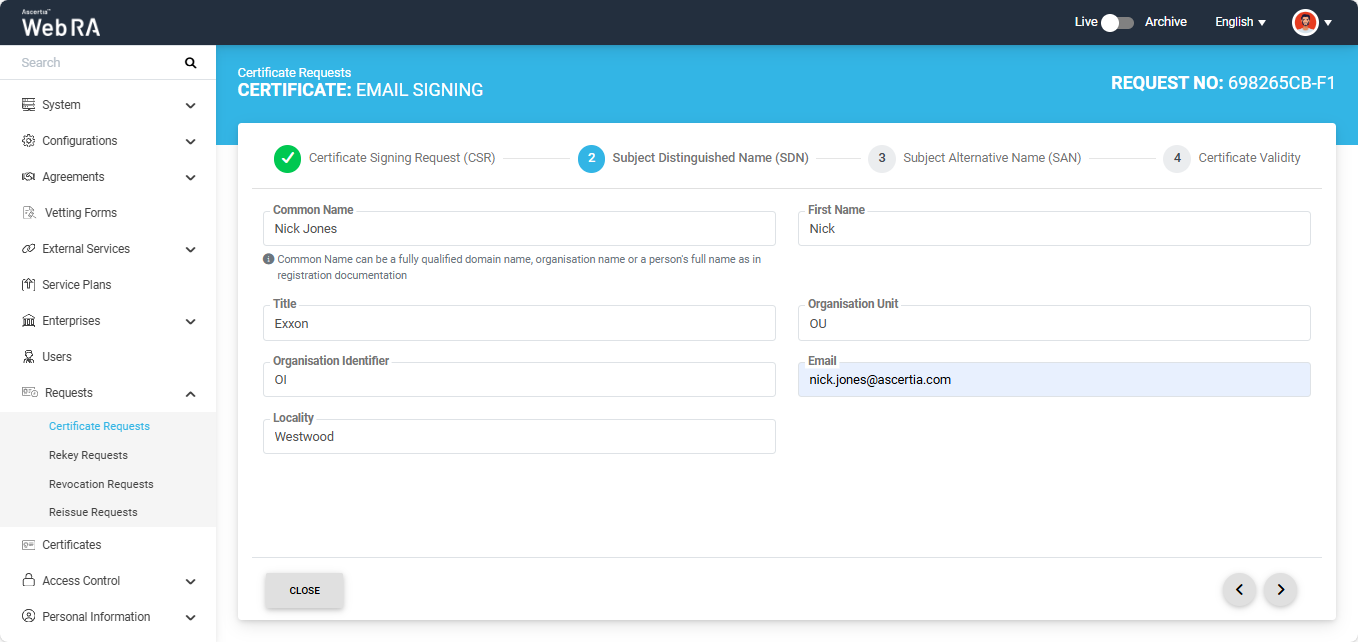
The Subject Alternative Name (SAN) screen will appear. Here, review or update the information in the fields as required.
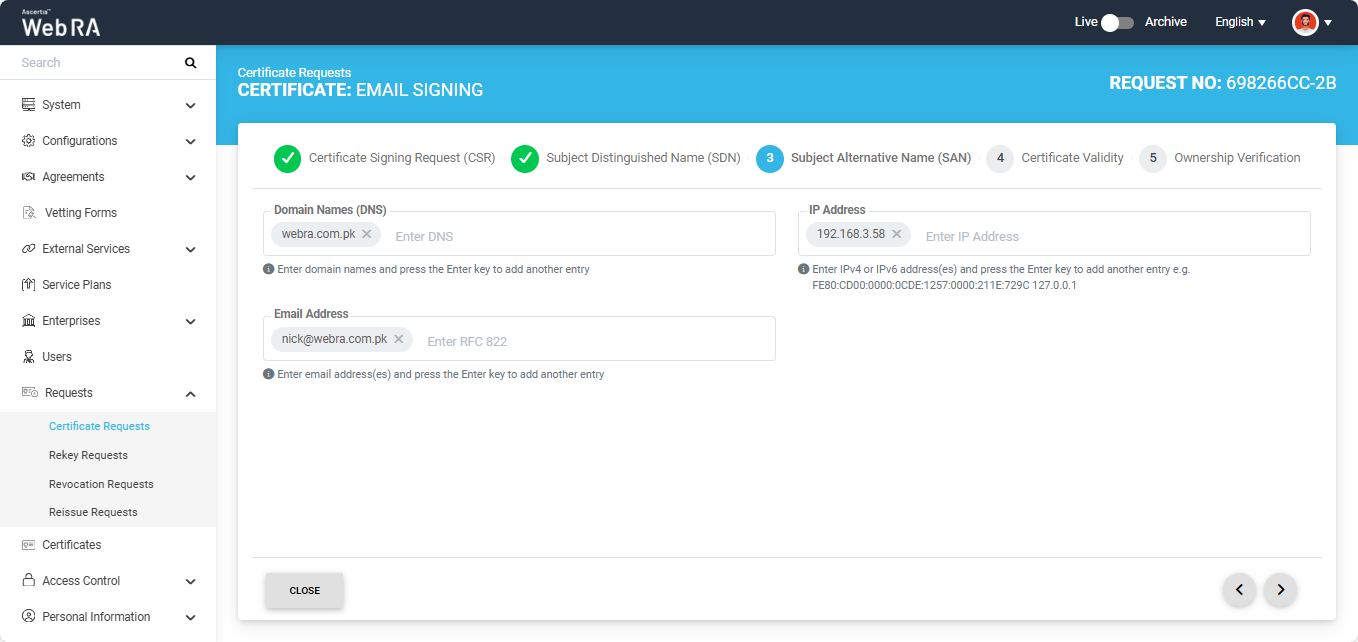
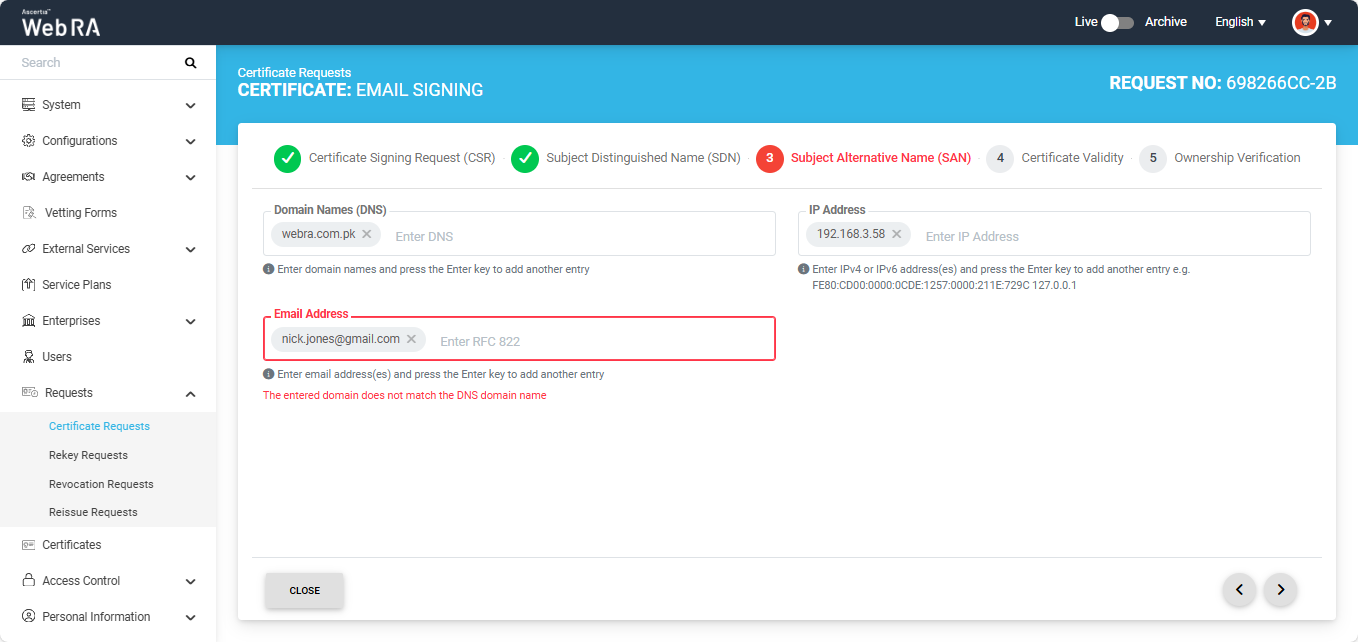
Note: Ensure that the domain in the Domain Names (DNS) and Email Address fields are the same. If the domains differ, the system displays an error and does not allow you to proceed.
After completing the SAN section click the next ‘>’ button to proceed. The 'Certificate Validity' screen will appear.
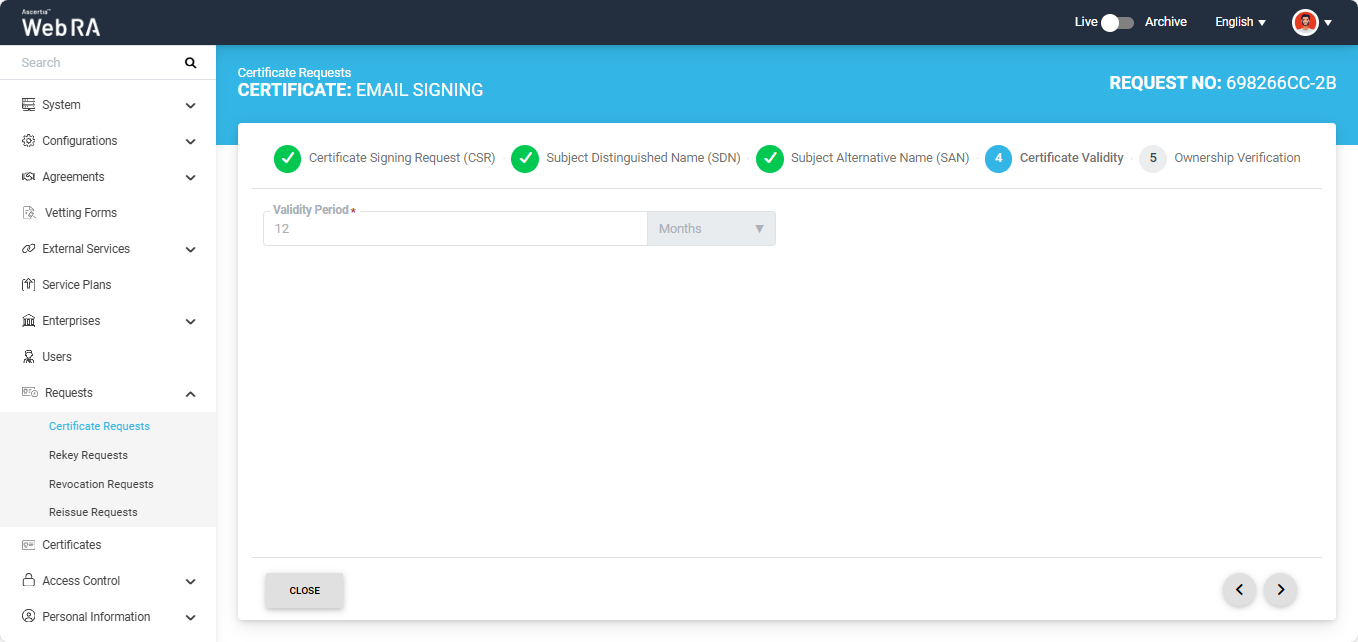
Click the next '>' button to navigate to the 'Ownership Verification' screen.
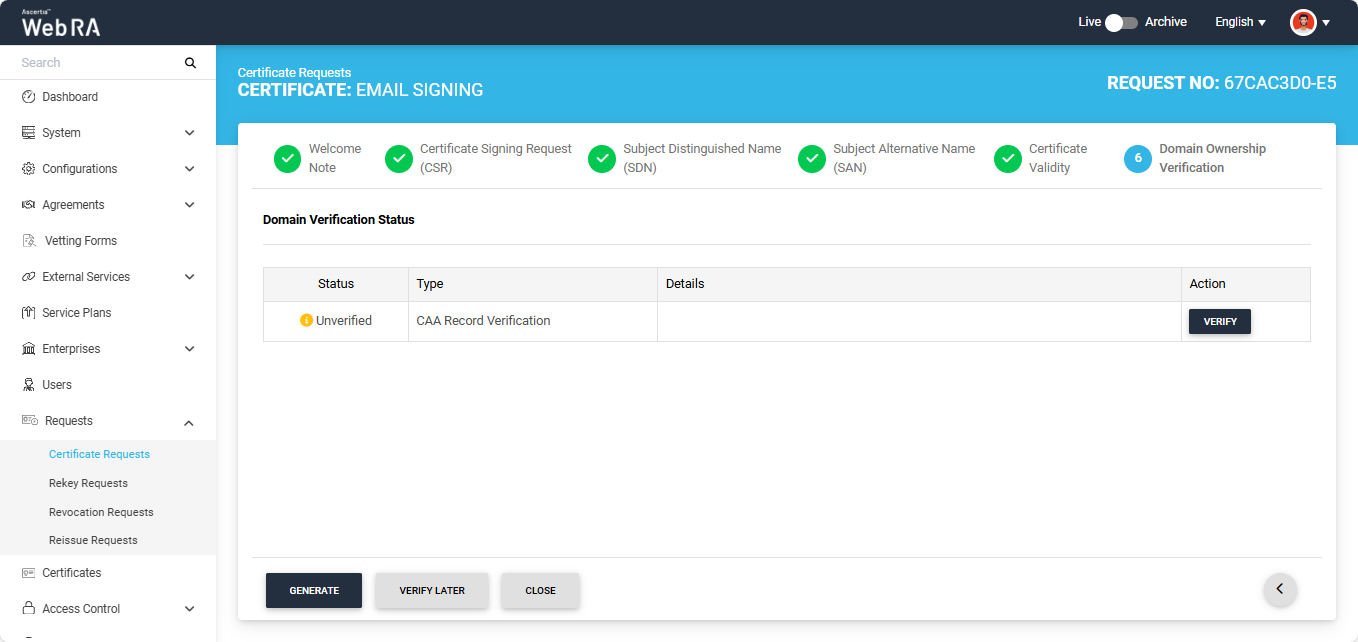
The Domain Verification Status will appear 'Unverified'. Click 'Verify' to proceed.
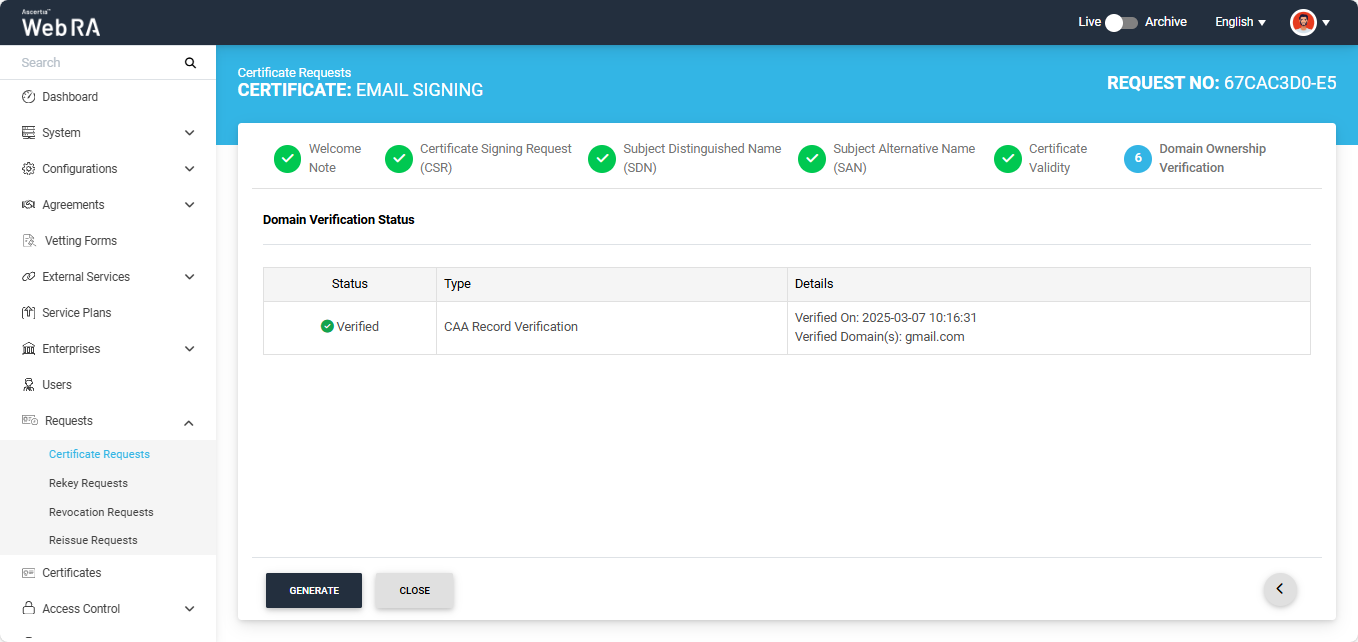
If the CAA records configured in the Enterprise Domain configurations match the domain of the entered email, the Domain Verification Status will appear as Verified, as displayed below.
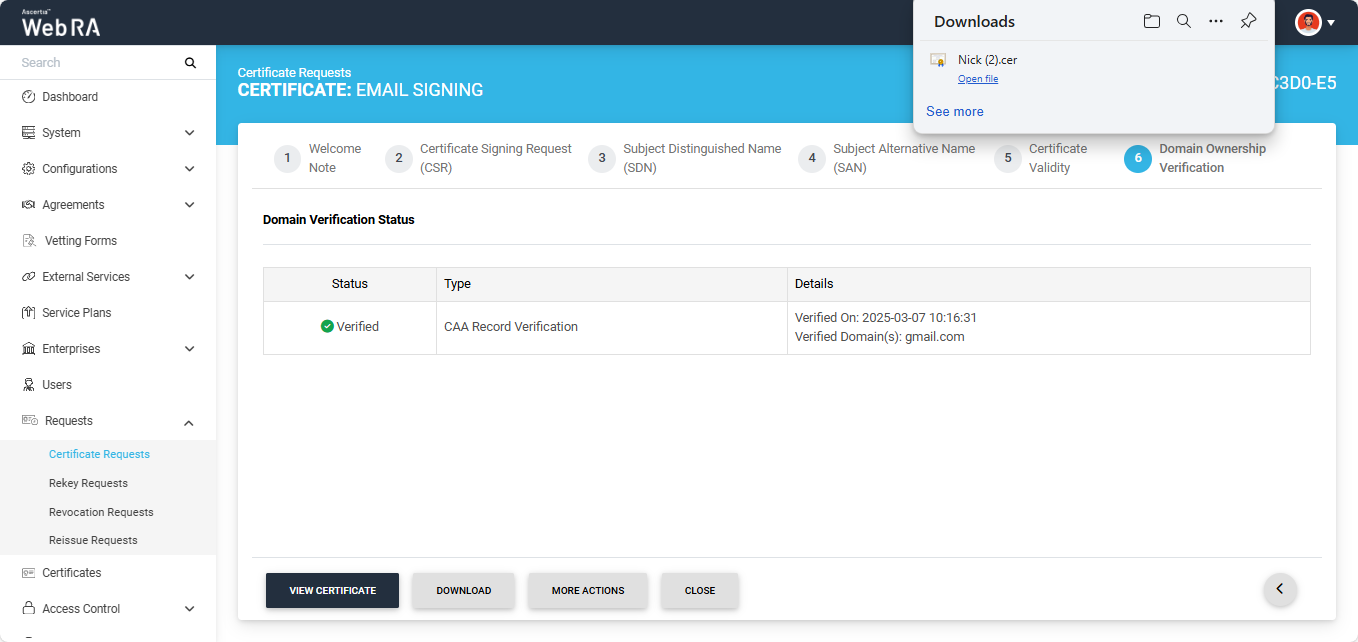
In case of Verified status, click 'Generate' to process a certificate. The certificate will be generated and downloaded in your computer.
Meanwhile, if the CAA records configured in the Enterprise Domain configurations do not match with the domain of any entered email, the Domain Verification Status will appear as ‘Unverified’.
The unverified domain name will appear in red text under the ‘Details’ column.
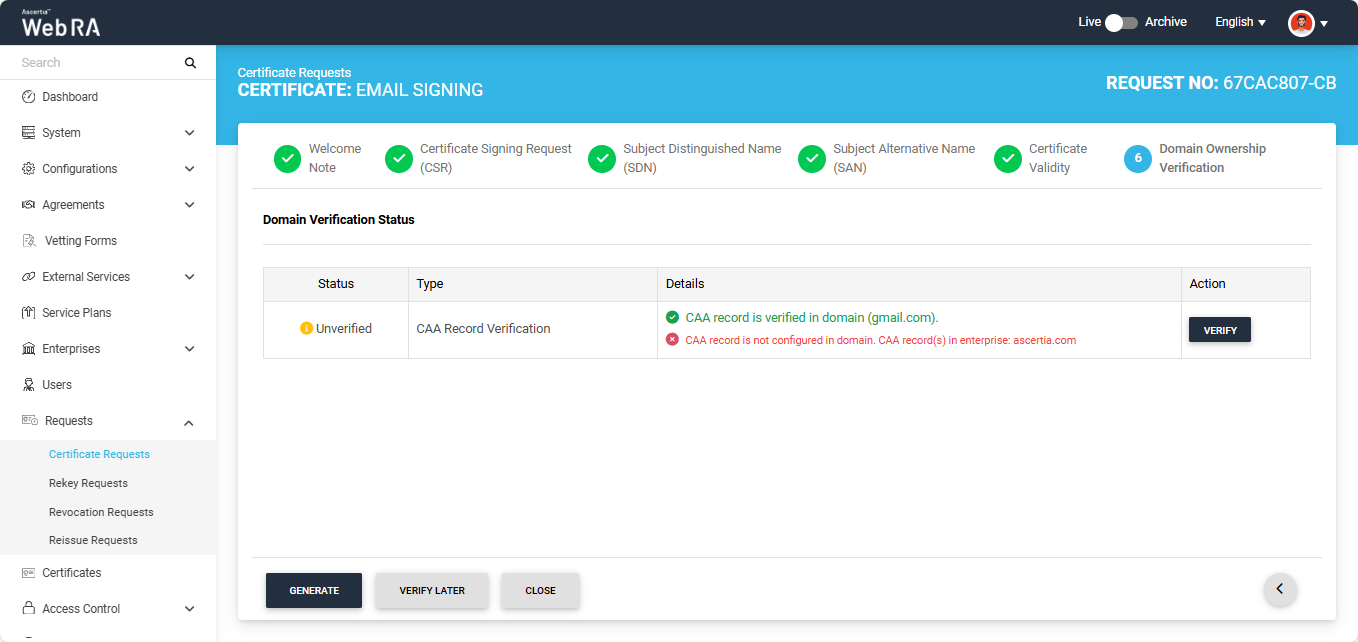
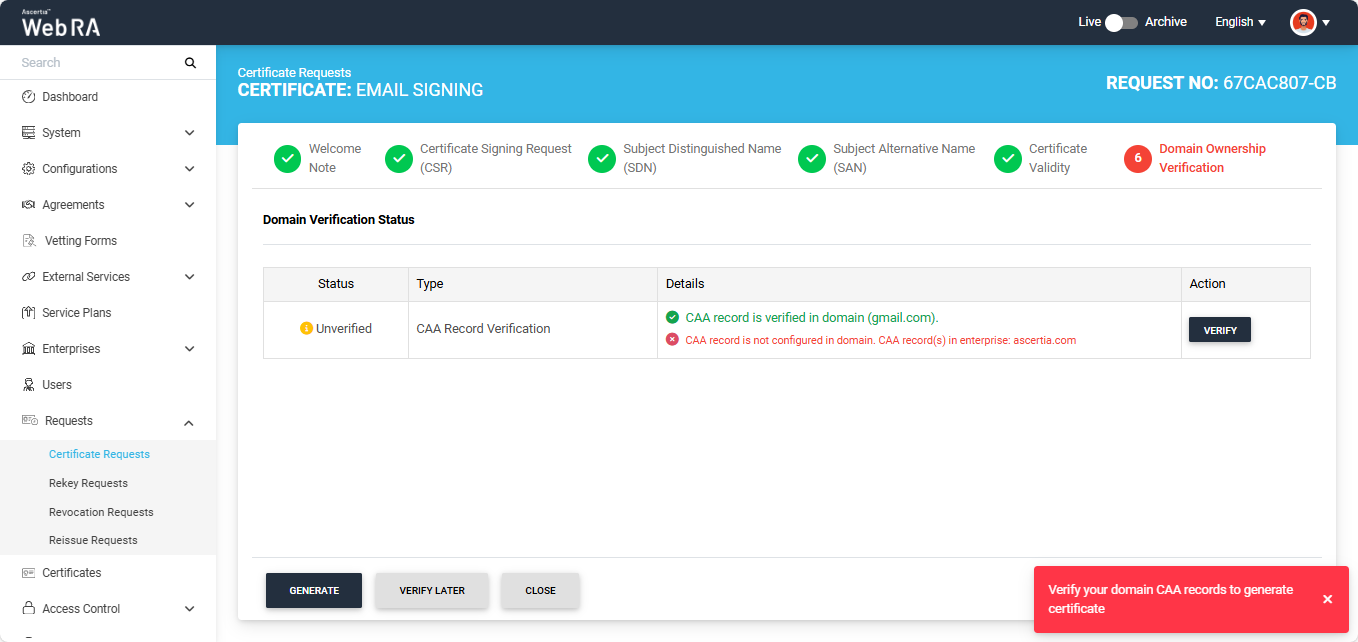
If you attempt to generate the certificate while the Domain Verification Status is ‘Unverified,’ the system will display an error dialog prompting you to verify your domain’s CAA records before proceeding.
If no CAA record is present, any CA is allowed to issue a certificate for the domain. If a CAA record is present, only the CAs listed in the record(s) are allowed to issue certificates for that hostname.
Note: If the ‘Generate a certificate on behalf of the user’ checkbox is enabled, the system will display an additional screen titled ‘User Information’ next to the 'Ownership Verification' screen.
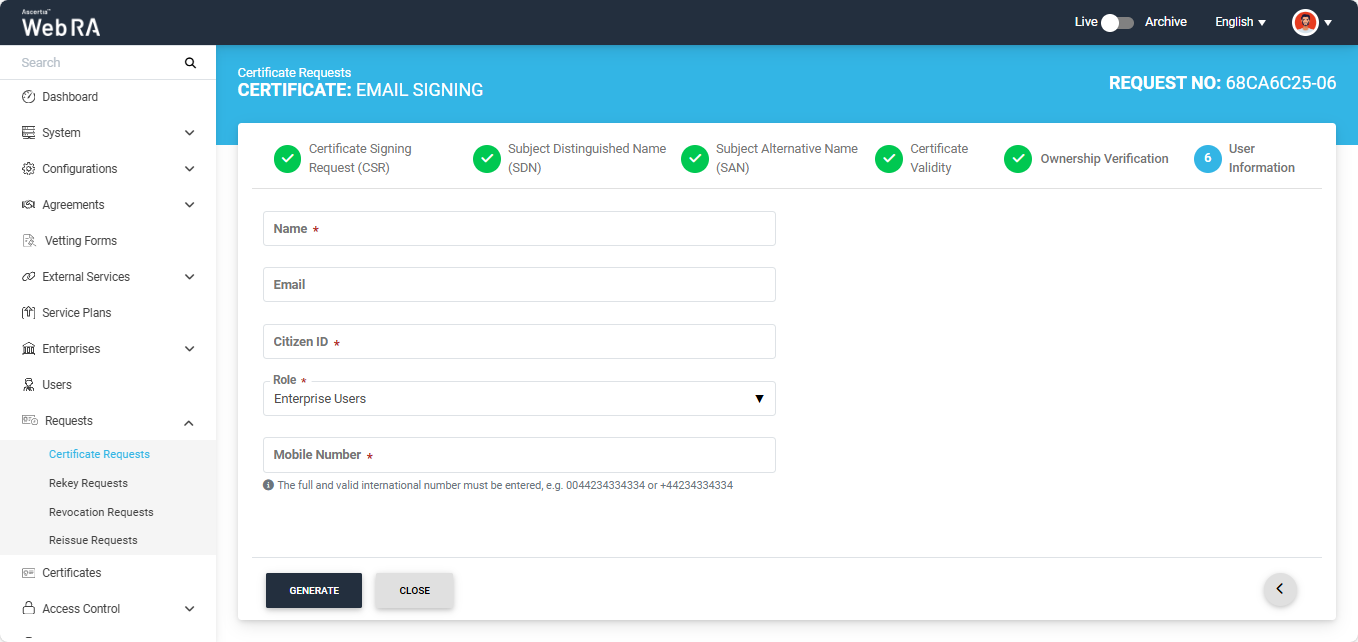
On the 'User Information' screen, you will be required to enter/select the Name, Email, Citizen ID, Mobile Number, and Role of the user for whom the certificate is being generated.
After entering the details, click ‘Approve’. The system will then display a subscriber agreement configured for this user's profile.
When you agree to the subscriber agreement, the system will create an account for the user and generate the certificate. The user will receive an email regarding the account and certificate creation and is prompted to activate their account.
Note: If the certificate is being created for a user who does not exist in the system, a new account will be created for the user along with the certificate.
If the user already has a registered account in the WebRA system, only the certificate will be created. The user will be notified via email about the certificate generation.
Meanwhile, if the user exists in the system but is not part of the enterprise where the certificate is being created, the system will send an invitation for the user to join that enterprise and will generate the certificate as well.